
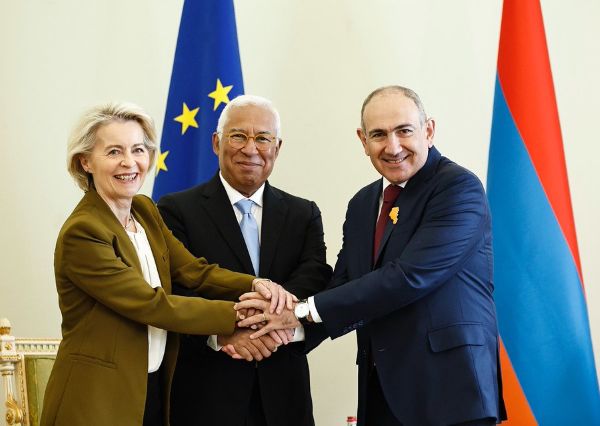
Armenia hosts its inaugural bilateral summit with the European Union on Tuesday, marking a historic diplomatic milestone for the country in the Caucasus. Armenia has formally expressed its intention to join the EU and is taking cautious steps to reduce its reliance on Russia. This summit in Yerevan follows the eighth meeting of the European Political Community, which convened numerous European leaders in the Armenian capital to discuss critical European security concerns and the ongoing US-Israeli conflict.
These meetings underscore Armenia’s strategic pivot toward the West and its desire to diminish Russian influence in the region. Relations between Armenia and Moscow have become increasingly strained since 2023, particularly following Azerbaijan’s full reclamation of the Karabakh region, which ended decades of governance by ethnic Armenian separatists.
Armenian officials have criticised Russian peacekeepers for their perceived failure to prevent Azerbaijan’s military actions. In response to these accusations, Moscow has argued that its troops do not possess a mandate for intervention, citing its focus on the ongoing conflict in Ukraine. Richard Giragosian, the director of the Regional Studies Centre in Yerevan, told The Associated Press that the current situation demonstrates Russia’s declining reliability as a regional partner.
Prime Minister Nikol Pashinyan‘s government encouraged closer ties with the West, and particularly with the European Union. Speaking at the EPC conference on Monday, EU Council President António Costa thanked Pashinyan for “the courageous political decisions he has taken to bring Armenia closer to the European Union.” “The direction of travel is unmistakable,“ Costa said. He emphasised that it was “vital to strengthen Armenian democracy and fight external interference and misinformation.” In her opening statement, European Commission President Ursula von der Leyen said that Europe was ready to help Armenia become a regional hub for global trade routes, including by building physical infrastructure.
“We’re ready to invest in the local energy production and the energy links across the Black Sea, and we are ready to connect your booming digital scene to Europe’s digital market and turn Armenia’s position at the heart of this region into a motor of growth,“ she said.
Shifting geopolitical dynamics
In 2023, Armenia became a member of the International Criminal Court, a decision that Moscow criticised as an “unfriendly step.“ The court subsequently issued an arrest warrant for Russian President Vladimir Putin, attributing personal responsibility to him for the abduction of children from Ukraine. In response to shifting geopolitical dynamics, Armenia suspended its participation in the Moscow-led Collective Security Treaty Organisation in 2024.
In 2025, the Armenian parliament enacted legislation that formally expressed the country’s intention to pursue membership in the European Union. As noted by Giragosian, the EU has begun to fill the void left by Russia, with EU engagement characterised as more prudent and productive than US involvement. He emphasised that European engagement is less likely to provoke Russia over the long term.
Despite these developments, Armenia remains a member of the Russia-led Eurasian Economic Union (EEU), which facilitates the free movement of goods, capital, and labour among its member states, including Belarus, Kazakhstan, and Kyrgyzstan. During discussions with Armenian Prime Minister Pashinyan earlier this year in Moscow, President Putin highlighted the challenges of dual membership, asserting that Armenia could not be a member of both the EEU and the EU. He pointed out that Armenia currently benefits from Russian natural gas at prices significantly lower than those on the European market.
While acknowledging this incompatibility, Pashinyan noted that Armenia could, at this time, balance its EEU membership with enhanced cooperation with the EU. Giragosian characterised the recent summit as an effort to deepen existing relationships rather than a progression toward formal candidacy. He referenced the Comprehensive and Enhanced Partnership Agreement that has structured EU-Armenia relations since its full implementation in 2021, stating, “The symbolic significance of this engagement is much greater as a message to Russia.”
How relations with the EU benefit Armenia
Concrete results are anticipated, according to Giragosian, including financing for domestic reforms and military assistance through the European Peace Facility, primarily aimed at supporting Ukraine. The EU has maintained a monitoring mission along Armenia’s border with Azerbaijan for several years, and a new mission to address hybrid threats has recently been approved.
Prime Minister Pashinyan, in office since 2018 and facing parliamentary elections in June, is likely to benefit from the international focus on the European meetings. Giragosian noted that Pashinyan’s government may remain in power largely because of a lack of credible opposition alternatives.
Giragosian cautioned against framing Armenia’s foreign policy as merely a shift from Russia to the West. He emphasised that Armenia is expanding its diplomatic efforts beyond this binary view, particularly through engagement with Japan, South Korea, and China. This approach, he stated, is more innovative and sophisticated than simply replacing one influence with another.
This article used information from The Associated Press.
