
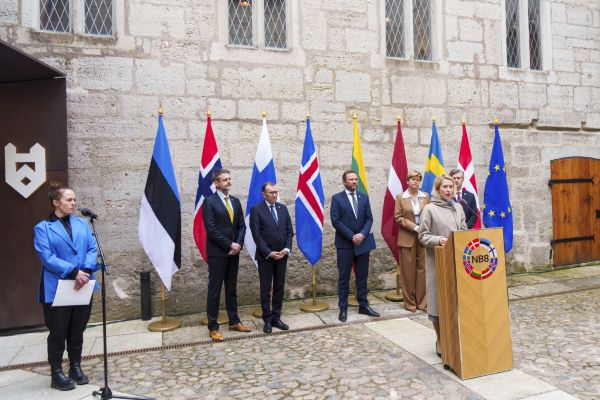
EU High Representative for Foreign Affairs Kaja Kallas stated that the European Union should not fall into the “trap” of Moscow’s maximalist demands. Speaking at the joint press conference with Foreign Ministers of the Nordic Baltic Eight (NB8) in Estonia on 30 April, Kallas emphasised that “the Russians always demand the maximum, ask something that has never been theirs, then present threats and ultimatums. And in the end, there will always be people in the West who will offer them something. So, let’s not walk into that trap.”
Kallas emphasised that the European Union should not be humiliated by seeking direct negotiations with Russia to resolve the ongoing conflict in Ukraine.
“What we have seen so far is that Russia does not want to engage in any dialogue. We should not humiliate ourselves by being the ‘demandeurs’: ‘please, we beg you to talk to us’. But we should put them in a position where they actually go from pretending to negotiate to actually negotiating,” she told journalists during the press conference.
Kallas noted that the Nordic–Baltic cooperation (NB8), which brings together Finland, Sweden, Norway, Iceland, Denmark, Estonia, Latvia and Lithuania to discuss current issues of regional and international importance, is the strongest supporter of Ukraine. With their support, Ukraine has managed to push Russia into a stalemate and, in doing so, has revolutionised modern warfare. The harsh reality on the battlefield indicates that Russia is suffering unprecedented losses in terms of soldiers.
Moreover, the European Union’s 90-billion-euro loan and the 20th sanctions package send a clear message: the EU is committed to providing Ukraine with the resources it needs to maintain its position until Vladimir Putin realises that his war is futile. Ukraine is more significant to Europe than to Russia, and Russia’s war objectives continue to falter, as is increasingly evident, emphasised Kallas.
For the first time in years, Moscow’s Victory Parade is set to take place without heavy military equipment, reflecting Russia’s challenging situation, noted Kallas. She pointed out that foreign ministers discussed the long-term threats posed by Russia, noting that hybrid attacks are now at their highest levels. Moscow often perceives hybrid warfare as cost-free, but we must work to alter this perception, she stressed. Kallas added that the European response should include more sanctions, accountability for war crimes, international isolation, and preventing access for Russian ex-combatants.
Beyond tactics like sabotage, disinformation, and cyber attacks, Russia is preparing its military for a prolonged confrontation with the West. Whether Putin chooses to challenge NATO depends entirely on the actions of its members. Deterrence is effective only if it is credible; showing weakness will only invite further aggression, stressed Kallas.
“If we want to keep our countries safe, we must continue to strengthen European defence readiness. This means surging defence spending, closing capability gaps, and scaling up European defence production. NB8 countries have already taken this message to heart. A more European NATO is long overdue,” emphasised the EU High Representative.
Kallas stressed that there can be no return to “business as usual” with Russia, even after the war in Ukraine ends. During the informal meeting of EU foreign ministers in Cyprus on 10 and 11 May, they will discuss their approach to Russia and outline expectations for the future to ensure that Russia does not threaten Europe. Kallas emphasised the need for the EU to agree on discussion topics before engaging with Russia.
