
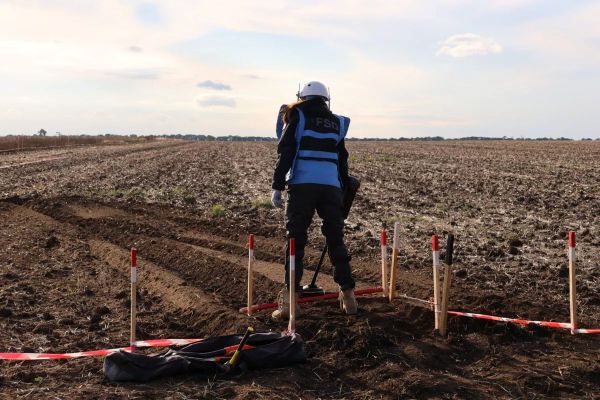
It’s 6 a.m. in Chuhuiv Raion, an agricultural region in eastern Kharkiv oblast and 40 kilometers from the frontline, when a Ukrainian demining team receives its final safety briefing. They’re now set to start scouring the open fields for landmines and unexploded ordnance.
Ilona Kartov has been working for six years with this team across Eastern Ukraine, where landmines have been piling up since Russia-backed separatists seized much of the country’s Donbas region starting in 2014. “My life now is drastically different,” says IIona, wearing a bulletproof vest and ballistic visor. “I used to own a dance school in Kramatorsk, where I taught hip hop and ballet to groups of children and adults.”
The ongoing war is remaking social expectations and responsibilities. With new male recruits sent to the front lines, women are stepping into traditional male roles, such as demining, logistics, and security functions. Ukraine is the world’s most mined country, with some 138,000 square kilometers, or roughly 20 percent of its territory, riddled with explosives.
Since 2022, unexploded ordnance and landmines have caused more than 1,000 civilian casualties in Ukraine, so the need is urgent. Women now make up about a third of Ukraine’s deminers, and that share is growing as NGOs increasingly recruit women, seeking the benefits of gender equity.
“Communities are more likely to feel confident in the demining process when they see that the concerns of everyone, including women, are taken seriously,” says Alex van Roy, Fondation suisse de déminage’s Regional Programme Manager in Ukraine. “As many of our national staff are themselves members of affected communities, promoting gender equality within our teams also contributes to social progress.”
Ilona’s days are mostly spent waving a long metallic arm over tall grass in search of unexploded Russian shells, grenades, cluster bombs and anti-personnel mines. Her team has found mines in playgrounds, homes, and cemeteries, as well as under water. Sometimes they are buried 16 metres, or more than 50 feet, underground.
The deminer’s life requires sacrifice. IIona’s 10-year old son lives in Lviv, Ukraine’s main western city, near Poland, with her mother and grandmother. “I feel my job now is more needed now than ever,” she said. “But Kharkiv isn’t a safe place for my son.”
Indeed, Kharkiv city is near the frontlines and a regular target of drone, missile and aerial bomb assaults. “Every day on our demining site, we can hear fighting in the distance,” says IIona. “From time to time, [Iranian-made] Shahed drones fly over us and attack infrastructure in nearby villages.”
Early this month, Russia carried out a large-scale drone attack on two Kharkiv residential areas, killing three people and wounding 60. “Our group hardly slept that night,” says IIona.” “At first, we were counting the explosions, but eventually, we all lost track.”
IIona is among Ukraine’s growing group of female deminers, or “sappers”, which includes hairdressers, beauticians, nurses, make-up artists and a judge. Tatiana Superson’s journey into demining began soon after Russia’s full-scale invasion in February 2022.
Giving up her beauty salon in a village north of Kyiv, she fled to Poland and started working as a waitress before applying to be a deminer with Norwegian People’s Aid. The humanitarian group is based in Mykolaiv and Kherson and nearly four out of 10 of its deminers (38%) are women. “It’s a job I was always interested in but was out of reach until the war began,” says Tatiana.
Tatiana now works with a team in Mykolaiv, a former occupied territory in northwest Ukraine, and regularly hears rockets from nearby Ukrainian artillery. “You never get used to the sound of war, but you learn to keep focused on the job,” she says. “Despite the risks, I wouldn’t want to go back to my old life.”
Ukrainian women had long been banned from becoming deminers, which was seen as too dangerous. But Russia’s 2022 invasion and the subsequent implementation of martial law changed that, opening up a handful of new patriotic career paths.
“The image of a female deminer is becoming more normalized, signalling a major cultural shift,” says Marijn van Broekhoven of Norwegian People’s Aid, Ukraine. “This shift is not only out of necessity, such as the conscription of men and the resulting labour gaps; it also reflects a broader redefinition of what roles women can and should play in crisis response and long-term recovery.”
This reflects a broader shift in gender roles in a society moving toward more inclusivity and fewer gender-related barriers in the workforce. “As women take on more visible and essential roles, they are not only reshaping the landscape of aid and recovery,” says van Broekhoven. “They are also challenging and transforming societal norms in a way that may have lasting impacts beyond the current conflict.”
