
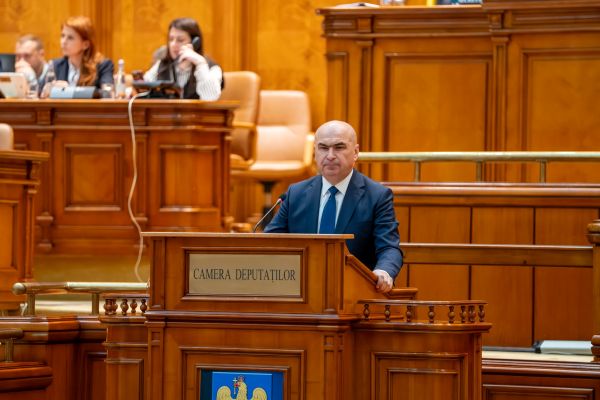
On Tuesday, Romania’s pro-European coalition faced a significant setback as lawmakers voted to remove Prime Minister Ilie Bolojan from office, less than a year after his inauguration, heightening political uncertainty in the EU. This no-confidence vote represents a considerable blow to Bolojan, who sought to resolve one of the most severe political crises in Romania’s post-communist history.
The Social Democratic Party (PSD) and the far-right opposition Alliance for the Unity of Romanians (AUR) jointly submitted the motion to Parliament on 28 April. In the previous month, the PSD withdrew from the coalition. In the vote, 281 lawmakers supported the motion, while only four opposed it. Members of Bolojan’s National Liberal Party (PNL), along with coalition partners Save Romania Union (USR) and the small ethnic Hungarian UDMR party, abstained.
In response to the situation, Romanian President Nicusor Dan called for calm, noting that while this outcome is “not a happy moment,” it reflects a “democratic decision by Parliament.” He assured the public that negotiations and informal consultations to establish a new government are currently underway, indicating, “we will have a new government within a reasonable time.” Dan also dismissed the likelihood of early elections, emphasising that “there will be a pro-Western government at the end of this process, and we will navigate through this situation with composure.”
Romania has been grappling with prolonged instability following the annulment of a presidential election in December 2024. In addition, the country faces one of the highest budget deficits in the European Union, coupled with rampant inflation and a technical recession.
When the coalition took office in June 2025, its primary commitment was to prioritise reducing the budget deficit. The PSD has frequently engaged in disputes with Bolojan over austerity measures, including tax increases, freezes on public-sector wages and pensions, and cuts to state spending and public administration roles. Recently, the PSD criticised Bolojan for “failing to implement any genuine reform” during his brief tenure, asserting that Romania requires a leader who can foster collaboration.
In defence of his position, Bolojan contended that he has implemented necessary fiscal measures that successfully “regained the trust of the markets in the Romanian government.” He characterised the no-confidence motion as “cynical and artificial,” suggesting it was proposed by individuals who lacked direct involvement in day-to-day governance and decision-making.
“It is cynical because it does not consider the context in which we find ourselves,” he stated. “I accepted the role of prime minister fully aware of the immense pressure associated with it and the likelihood of not receiving popular acclaim. However, I made the choice to pursue what was urgent and necessary for our country.”
Sorin Grindeanu, the president of the PSD party, has stated that Bolojan should appoint an interim prime minister until lawmakers duly elect a new one. He also emphasised the expectation that Romanian President Nicușor Dan will engage in consultations with the PSD. “I would like us to quickly arrive at a solution in collaboration with the other parties and move forward,” Grindeanu remarked. “All options remain on the table.”
Dan Motreanu, the secretary-general of Bolojan’s party, shared his thoughts on social media, asserting that both the PSD and AUR have a responsibility to assume leadership of the government, propose a candidate for prime minister, and present a clear programme. He criticised the two parties for “engaging in political theatre,” stating, “One cannot overthrow a government and subsequently evade responsibility,” while highlighting that any indication of political instability adversely affects the nation’s economy and its citizens.
The PSD’s involvement will be crucial in establishing a pro-European parliamentary majority. However, the party has previously ruled out forming a governing coalition with AUR, whose leader, George Simion, pointed out that voters had anticipated essential services such as “water, food, and energy,” yet faced challenges including “taxes, war, and poverty.”
Cristian Andrei, a respected political consultant based in Bucharest, commented that the current situation is likely to lead to a stalemate, as “no party has a majority or coalition.” Consequently, it may take the president several weeks to identify a viable majority and appoint a new prime minister, prolonging the period of indecision.
Currently, there are two potential pathways to forming a new Cabinet, both of which present significant challenges: either a reshuffled coalition without Bolojan, or a minority Cabinet likely led by the PSD, possibly supported by far-right parties like AUR or other smaller factions. It is important to note that a formal Cabinet comprised of both PSD and AUR is unfeasible at this time, as the president is unlikely to endorse such an arrangement.
The position of prime minister is scheduled to rotate in 2027 from the liberal Bolojan to a PSD premier, as outlined in their power-sharing agreement, while a general election is scheduled in 2028.
