
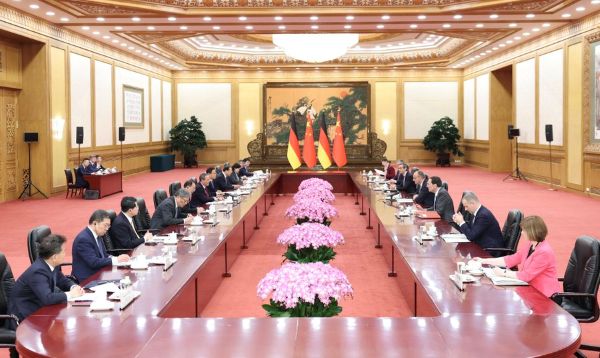
China and Germany have divergent perspectives on several significant issues, particularly regarding Russia’s war in Ukraine. Nevertheless, the leaders of these two influential economies — the world’s second- and third-largest — pledged on Wednesday to enhance their collaboration amid global uncertainty. Both countries have experienced the repercussions of US policies under President Donald Trump, who underscored the importance of his import tariffs in a State of the Union address delivered just hours before German Chancellor Friedrich Merz met separately with Chinese leader Xi Jinping and Premier Li Qiang in Beijing.
This visit marked Chancellor Merz’s first trip to China since assuming office in May. During this trip, he has advocated for a more robust Europe, both economically and militarily, to ensure the continent can navigate the evolving global landscape effectively. Before he departs for China on Tuesday, he remarked that, despite differences between Europe and China, addressing today’s major global political challenges requires Beijing’s involvement.
“The more turbulent and complex the world becomes, the more China and Germany should strengthen strategic communication and enhance strategic mutual trust,” Xi said at the government’s Diaoyutai state guesthouse, a leafy and sprawling property dotted with grand buildings.
The year has commenced with notable challenges, and, as previously stated, the world is undergoing significant transformations comparable to those witnessed since the conclusion of World War II. In response, Merz emphasised that while various issues and challenges require attention between the two countries, it is essential to focus on shared interests and collaboratively address the challenges that lie ahead. Following his discussions, the chancellor told reporters that he had urged the Chinese leadership to use their influence to bring an end to the ongoing conflict in Ukraine.
“We know that signals from Beijing are taken very seriously in Moscow — that goes for words as well as deeds,” he said.
Many European governments are frustrated with China’s reluctance to pressure Russia to end the conflict in Ukraine. China has maintained its trade and diplomatic ties with Russia, maintaining an impartial stance. President Xi Jinping informed German leader Friedrich Merz that China supports a political solution that respects “the legitimate concerns of all sides” and allows for “equal participation of all parties.”
Merz’s visit is part of a trend of world leaders travelling to Beijing as China seeks support amid former President Trump’s tariff policies and challenges to the global order established after World War II. Merz emphasised the need for Germany’s China policy to align with European interests, following visits by Emmanuel Macron and Keir Starmer, and ahead of Trump’s planned trip in early April.
“Our message from a European point of view is the same: We want a balanced, reliable, regulated and fair partnership with China,” Merz said. “This is our offer. At the same time, it is what we also hope for and expect from the Chinese side.”
Chinese exports pose a threat to factory jobs in Europe. Last year, Germany’s imports from China rose by 8.8% to €170.6 billion, while exports to China fell by 9.7% to €81.3 billion. European leaders are advocating that Chinese companies set up factories in Europe and that China reduce manufacturing overcapacity that drives down prices in sectors like electric vehicles and solar panels.
Merz expressed satisfaction with recent talks, citing the potential for business deals, including a plan for China to order up to 120 Airbus planes. He noted that Germany’s trade deficit with China has quadrupled since 2020, indicating an unhealthy dynamic that needs to be addressed.
Xinhua commented that both countries must oppose protectionism and economic coercion. Merz’s visit also includes a trip to Hangzhou to visit Unitree Robotics, a leading developer of humanoid robots, ahead of his third visit to Washington as chancellor.
