
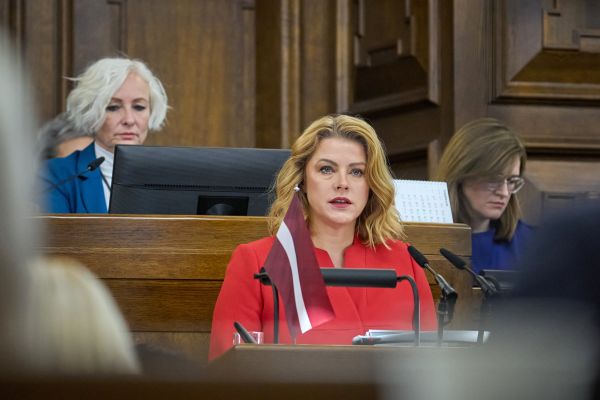
On 5 November, Latvian lawmakers decided to indefinitely postpone a vote concerning the withdrawal from the Istanbul Convention, a European treaty focused on combating violence against women. This decision will remain in effect until after the parliamentary elections scheduled for October of next year. The postponement has been positively received by Prime Minister Evika Siliņa, who is opposed to leaving the treaty.
The Council of Europe treaty, which took effect in Latvia in 2024, aims to standardise support systems for women facing violence, including domestic abuse. As expected, it has faced criticism from far-right and ultra-conservative parties across Europe, who argue that the treaty promotes “gender ideology,” encourages sexual experimentation, and threatens children.
The 2022 general elections in Latvia indicated a notable shift in voter sentiment toward ultra-conservative and far-right political parties. In September, a coalition of 32 opposition lawmakers began the process to withdraw Latvia from the treaty, led by Ainars Slesers of the far-right Latvia First (LPV) party. Slesers has called on citizens to choose between a “natural family” and a “gender ideology with multiple sexes.” Although LPV comprises only eight lawmakers out of a total of 100 in the Saeima (Latvia’s parliament), the party is recognised for its anti-vaccine stance. It is affiliated with the far-right group Patriots for Europe.
Support for the withdrawal initiative has also been received from the Union of Greens and Farmers (ZZS). This nationalist agrarian alliance is part of the tripartite governing coalition, led by the centre-right New Unity (JV) party, headed by Prime Minister Siliņa.
Additionally, the anti-Istanbul Convention movement has garnered support from two members of the European Conservatives and Reformists (ECR), namely the United List (AS) and the National Alliance (NA), as well as the Russian minority party, For Stability (ST!). A total of 56 lawmakers voted in favour of the proposal to withdraw from the treaty.
Opponents of the treaty contend that they object to its language defining gender as a social construct, asserting that Latvia’s domestic laws already provide sufficient protection against violence towards women. Consequently, on 30 October, the Latvian Parliament voted on the withdrawal from the Istanbul Convention following a lengthy 13-hour session marked by intense debate. More than 5,000 supporters of the treaty demonstrated outside the parliament against the proposed withdrawal.
Prime Minister Siliņa, whose coalition government assumed office in 2023 with a commitment to ratifying the convention, has voiced her opposition to the withdrawal efforts. If the withdrawal were approved, Latvia would become the first EU country to exit a treaty designed to combat violence against women.
Following the vote in the Saeima, President Edgars Rinkēvičs declined to endorse the withdrawal. Although the parliament can still enact the measure with a subsequent vote, lawmakers have accepted President Rinkēvičs’s request to schedule this new vote after the elections next year. In this instance, New Unity, The Progressives (PRO), the National Alliance, and the United List collectively supported the postponement of the vote.
“Latvian parliament has voted to indefinitely postpone the withdrawal from the Istanbul Convention. I welcome this vote. It is a victory of democracy, rule of law and women’s rights,” Prime Minister Evika Silina posted on X.
“It is a victory of the Latvian people. Latvia is a reliable partner and ally, and remains committed to European values”, highlighted the Latvian PM.
