
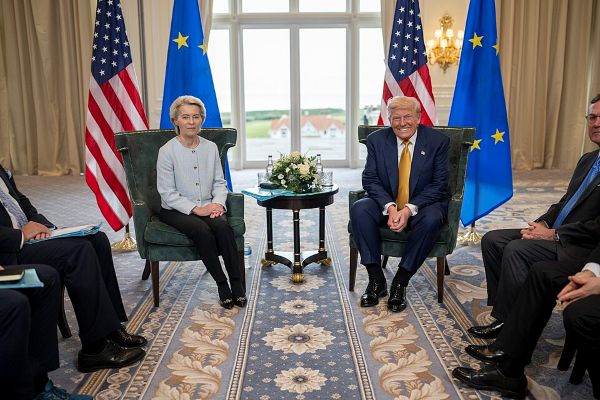
The United States has formally communicated to the European Union the potential consequences of not accepting a customs agreement, specifically highlighting the risk of losing advantageous access to liquefied natural gas (LNG). The Financial Times reported following a discussion with the US Ambassador to the EU, Andrew Puzder.
The European Parliament is expected to vote on Thursday on the tariff agreement reached by US President Donald Trump and European Commission President Ursula von der Leyen during their July 2025 meeting at Turnberry, Scotland. As part of this agreement, the EU has pledged to reduce tariffs on specific agricultural imports from the United States.
Furthermore, the Financial Times noted that the accord entails the EU’s commitment to purchase US energy resources valued at $750 billion by 2028, encompassing LNG, oil, and civilian nuclear technologies. Ambassador Puzder emphasised to the publication that the energy component of the trade deal could be jeopardised if the EU attempts to modify any other terms of the agreement. He stated that if the agreement is not executed as planned, both parties may find themselves starting anew.
While the United States would still be interested in conducting business with Europe, Ambassador Puzder indicated that the terms might not remain as favourable, and the overall environment for negotiations could shift due to the presence of alternative buyers.
It is important to note that the upcoming vote by the European Parliament does not finalise the EU’s acceptance of the agreement. If the Parliament votes in favour, negotiations will proceed among the Parliament, member states within the Council, and the European Commission to finalise the agreement.
