
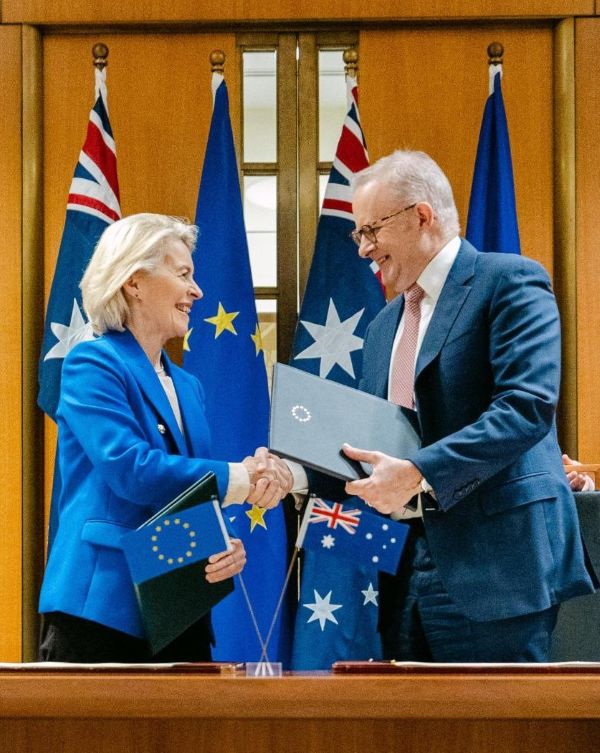
On Tuesday, the European Union and Australia finalised the text of a free trade agreement, marking a notable achievement nearly two years after negotiations initially faltered. The breakdown stemmed primarily from Australia’s request for greater access to the red meat market and concerns about the use of traditionally European names, such as prosecco, for Australian products.
This significant agreement comes as both parties endeavour to diversify their trading relationships, reduce economic reliance on China, and mitigate exposure to the uncertainty of tariffs imposed by the United States.
European Commission President Ursula von der Leyen and Australian Prime Minister Anthony Albanese formally signed the agreement at Parliament House in Canberra, concluding negotiations that began in 2018. The leaders underscored that this pact represents the mutual benefits derived from adhering to rules-based trade.
“Today we are telling an important story to a world that is deeply changing. A world where great powers are using tariffs as a leverage and supply chains as vulnerabilities to be exploited,” von der Leyen told reporters.
“In our story, open rules-based trade delivers positive some outcomes. Trust matters more than transactions,” she added.
Albanese stated that the agreement’s context was crucial to enabling the negotiations, which had collapsed in October 2023, to resume.
“This is both the European Union and Australia asserting that we believe in free and fair trade, that we understand that trade advances the prosperity of both trading entities who are involved, that it is in our interest to get this done,” Albanese said.
The two leaders have also announced a new defence partnership that aims to strengthen military cooperation and initiate negotiations for Australia to become an associate member of the Horizon Europe research and innovation funding programme.
Prime Minister Albanese emphasised that this partnership will establish a framework for collaboration between the European Union and Australia on various global challenges. The areas identified for cooperation include defence industries, maritime security, cybersecurity, counter-terrorism, and addressing hybrid threats such as disinformation. He stated, “This partnership underscores our shared commitment to global peace and security, reinforcing our unwavering support for Ukraine in response to Russia’s illegal full-scale invasion.”
Furthermore, the agreement will eliminate tariffs on key Australian exports, including wine, seafood, and horticultural products. The European Union has committed to opening two tariff-rate quotas, totalling 30,600 metric tons, for Australian red meat, with 55% of this amount duty-free. Under the terms of the trade deal, Australian producers of prosecco—traditionally a sparkling wine from Northern Italy—will be prohibited from using the name for exports ten years following the agreement’s implementation. A start date for the pact has yet to be determined. This arrangement will also enhance the EU’s ability to secure essential raw materials, including lithium and tungsten.
Hazel Moir, an economist from the Australian National University’s Center for European Studies, observed that both European and Australian stakeholders are keen to finalise the agreement in response to US President Donald Trump‘s initiatives to impose global tariffs. However, she noted that it is premature to predict the impact on bilateral trade, as the full text of the agreement has not yet been released.
“What’s changed is all of Trump’s behavior on tariffs. So everyone got nervous and they wanted to do other things,” Moir said.
An EU free trade agreement with four South American nations will take effect on 1st May, following over 25 years of negotiations amid new global economic uncertainty.
This article used information from The Associated Press.
