
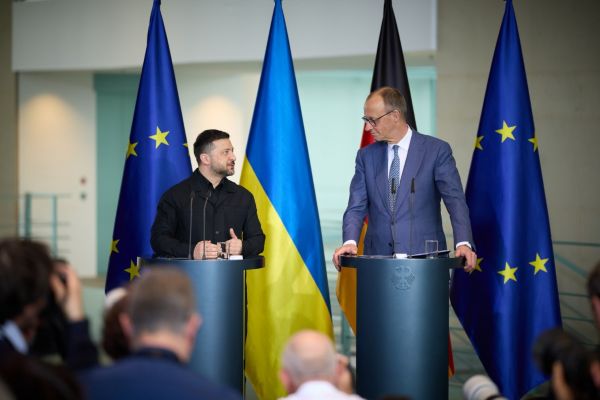
German Chancellor Friedrich Merz has proposed that the European Union consider offering “associate membership” to Ukraine as a means to revitalise negotiations aimed at terminating the prolonged conflict with Russia, which has persisted for over four years. This initiative was detailed in a letter addressed to the EU’s senior officials, recently reviewed by The Associated Press.
Chancellor Merz’s suggestion arrives as the 27-member bloc considers initiating its own discussions with Russian President Vladimir Putin, particularly as US-mediated negotiations have encountered significant challenges amid a shift in American focus to the situation in Iran.
Under the proposed framework, Ukraine would participate in EU meetings without possessing voting rights. Additionally, the country would have non-voting “associate member” status within key EU institutions, such as the European Commission and the European Parliament.
Chancellor Merz asserted that this arrangement would not be considered “membership light,” emphasising that it would “go far beyond” the existing Association Agreement governing EU-Ukraine relations.
Furthermore, he suggested establishing a “snap-back mechanism” to address any potential regression in Ukraine’s democratic standards. European Council President António Costa and European Commission President Ursula von der Leyen reaffirmed their commitment last month to commence official membership talks with Ukraine “without delay,” a call that Chancellor Merz also supports in his letter.
On Wednesday, Ukrainian President Volodymyr Zelenskyy expressed optimism regarding possible advancements in Ukraine’s accession negotiations with the European Union. In his address, he highlighted the significance of this progress, stating that Ukraine has diligently fulfilled all necessary criteria for advancement.
Candidate countries seeking EU membership must align their legislation across 35 policy areas, commonly referred to as “chapters.” For any chapter to be opened for negotiation, consensus among all 27 EU member states is required, and the same agreement is essential for the closure of each chapter. Notably, Hungary has previously impeded the opening of negotiations, but the recent establishment of a new government in Budapest may lead to a shift in this stance.
While the proposal put forth by German leaders may not resonate with some European officials advocating for a merit-based approach to EU membership, it has been suggested that this strategy could be extended to other candidate nations, particularly those in the Western Balkans. EU leaders are scheduled to convene for a summit next month to discuss these matters further.
Merz stated that his proposal “will help facilitate the ongoing peace talks as part of a negotiated peace solution,” which is crucial for both Ukraine’s and Europe’s security. Ukraine views EU membership as a “security guarantee“ for a stable future, while NATO membership remains uncertain amid ongoing hesitations.
With US-led mediation efforts stalled, EU countries are considering initiating their own negotiations with Russia. Costa emphasised the need to address common security issues with Russia without disrupting US-led talks. Speculation surrounds potential EU negotiators, including former German Chancellor Angela Merkel and former European Central Bank chief Mario Draghi. Putin has also mentioned Gerhard Schröder as a possible negotiator, but the idea has faced scepticism in Germany due to Schröder’s ties to the Russian energy sector.
EU foreign policy chief Kaja Kallas warned against allowing Putin to choose a negotiator. Zelenskyy has supported greater European involvement in the negotiations, stressing the importance of Europe’s presence in the process.
This article used information from The Associated Press.
