
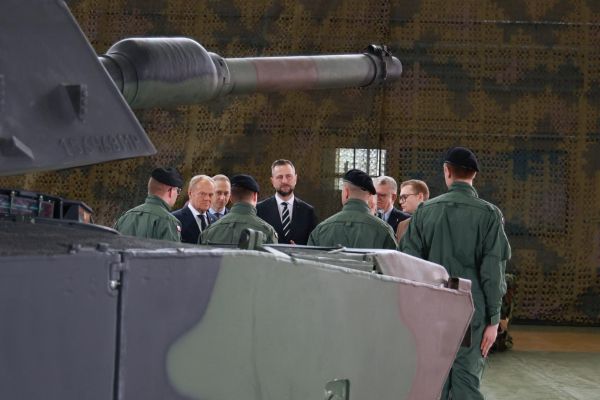
Polish officials expressed satisfaction with the clarification from US officials regarding the temporary postponement of the deployment of 4,000 US troops to Poland. The Polish government had previously reacted with surprise to the announcement that troops from the Army’s 2nd Armoured Brigade Combat Team, 1st Cavalry Division, would no longer be proceeding to the country, which shares a border with Ukraine.
The Trump administration’s decision to reduce US forces in Germany has generated concerns and criticism across both Europe and Washington. Chief Pentagon spokesperson Sean Parnell characterised the delay in troop deployment to Poland as a “temporary measure” and highlighted Poland’s status as a “model U.S. ally.” Notably, Poland contributes the highest percentage of its gross domestic product—approximately 4.7% in 2025—towards NATO defence expenditures.
Parnell explained that the delay was a consequence of the US altering the number of brigade combat teams stationed in Europe from four to three, which necessitates strategic decision-making regarding troop assignments. Vice President JD Vance reinforced this perspective, clarifying that the situation should not be viewed as a reduction in troop levels in Poland, but rather as a standard rotation delay that can occur in such circumstances.
Polish Prime Minister Donald Tusk expressed his satisfaction with Washington’s confirmation that Poland would receive the respect it deserves. Additionally, Polish Defence Minister Władysław Kosiniak-Kamysz, who met with Defence Secretary Pete Hegseth, indicated that recent US statements affirm the sustained presence of US forces. He remarked, “Sometimes a rotating model can change into a permanent model, which is generally more advantageous.”
Typically, around 10,000 US troops are stationed in Poland, with the majority present on a rotational basis. Polish officials have been informed that they will be included in discussions regarding the reorganisation of US military personnel in Europe. The US government has not yet specified the duration of the delay, and the Polish defence minister is hopeful for further clarification on troop presence in the coming weeks.
However, Prime Minister Tusk has emphasised the importance of recognising that there is no illusion about Washington’s intention to scale back its military presence in Europe, necessitating a greater responsibility on the part of European nations. On Wednesday, NATO Secretary-General Mark Rutte stated that US allies have been aware for some time that the Trump administration intends to withdraw a portion of its troops from Europe, thereby expecting Europe and Canada to assume an increasingly significant role in the conventional defence of NATO, particularly in its European component.
Rutte affirmed that while the US will continue to be involved, it may gradually reallocate resources to other regions of the world. The Trump administration has reiterated that Europe must enhance its own security posture, including Ukraine’s, going forward. Additionally, plans to reduce the number of troops stationed in Germany by at least 5,000 have been discussed following Chancellor Friedrich Merz‘s comments on perceived challenges the US faces in its foreign policy.
This article used information from The Associated Press.
