
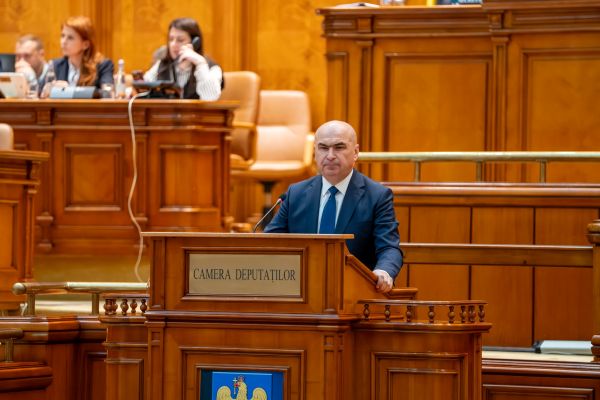
On 14 May, the European Commission released a positive preliminary assessment regarding Romania’s fourth payment request for €2.62 billion under the Recovery and Resilience Facility (RRF), a central element of the NextGenerationEU initiative. The Commission concluded that Romania has effectively met the requirements of 38 milestones and 24 targets specified in the Council Implementing Decision. This notable achievement can be attributed to the previous government led by Ilie Bolojan, which instituted robust fiscal reforms designed to align Romania’s economy with its commitments as an EU member.
However, his pro-European government faced a significant setback as lawmakers voted to remove PM Bolojan from office on 5 May, less than a year after his inauguration, heightening political uncertainty in the EU. This no-confidence vote was the result of an alliance between the Social Democratic Party (PSD) and the pro-Kremlin far-right opposition Alliance for the Unity of Romanians (AUR), which jointly submitted a motion to the Romanian Parliament on 28 April.
The approval of this payment request is crucial to advancing initiatives in sustainable forest management, decarbonisation of the transport and energy sectors, tax administration reform, public pensions, healthcare infrastructure, and social services for individuals with disabilities. Furthermore, these funds will contribute to strengthening government decision-making processes, advancing digitalisation, enhancing the efficiency of the justice system, reinforcing anti-corruption efforts, and supporting the development of the education system.
Key measures outlined in this payment request include:
a. The deployment of a government cloud that connects over 30 public institutions to the infrastructure, enhancing data sharing and improving public services.
b. Decarbonisation initiatives to speed up Romania’s transition to a low-carbon economy by increasing ownership taxes on polluting vehicles and gradually reducing its reliance on coal-fired power.
c. Review of the tax framework, advancing the reforms introduced by the Bolojan government, aiming to create a fairer and more efficient tax system. These changes seek to reduce administrative burdens and improve tax compliance.
The Commission has submitted its preliminary assessment of Romania’s progress on these milestones to the Economic and Financial Committee (EFC), which has four weeks to provide feedback. The payment to Romania will proceed in accordance with the EFC’s opinion and the Commission’s subsequent decision.
“The €2.62 billion approved today by the @EU_Commission for #Romania under the Recovery and Resilience Facility comes after reforms implemented by the center-right, pro-European, reform-oriented interim Prime Minister Ilie @Bolojan. His government delivered long-delayed fiscal reforms from the previous Socialist Government, and measures to improve the governance of state-owned companies, reforms required to unlock EU funding and strengthen Romania’s public finances. This is what a serious, pro-European government looks like: reforms implemented, #EUfunds secured, and public interest placed above party networks,” stated MEP Siegfried Mureșan, Vice-President of EPP.
