
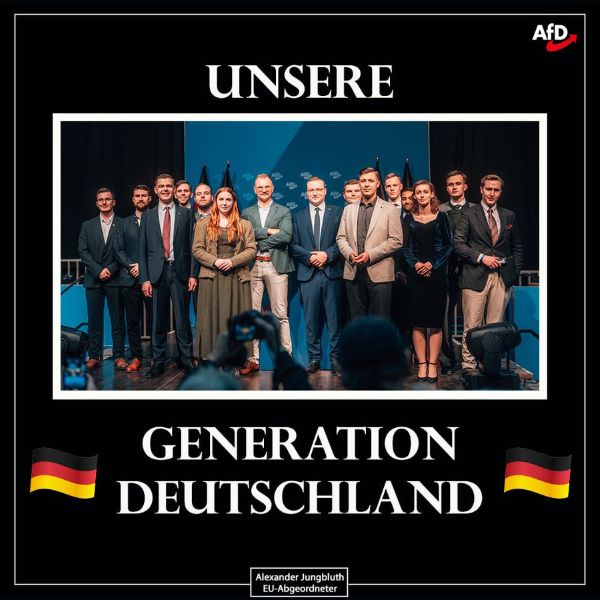
The right-wing extremist party Alternative for Germany (AfD) established its new youth organisation on Saturday following the dissolution of its previous youth group. A significant number of protesters gathered in the western city of Giessen, where the party held its meeting, resulting in several confrontations with law enforcement.
The prior youth organisation, known as the Young Alternative, maintained relatively loose ties to the party and was dissolved in March, when the AfD formalised its separation from the group. Due to the party’s extremist policies and statements from some of its members, the German judicial system may consider banning the AfD. Consequently, the party’s leadership intends to exercise much closer oversight over the newly formed group, Generation Germany, which is open to all party members under 35. The statutes for this new youth organisation were approved during a founding congress held on Saturday.
Unlike its predecessor, membership in this new group requires individuals also to be members of the AfD, making them subject to the disciplinary authority of the main party. Germany’s domestic intelligence agency previously concluded that the Young Alternative was a recognised right-wing extremist group, followed by a classification of the AfD itself as such, which was later suspended after the party pursued a legal challenge.
In a ruling last year, a Cologne court dismissed a call for an injunction against the Young Alternative designation, noting that the preservation of an ethnically defined German identity and the exclusion of the “ethnically foreign” were central political tenets of the group. The court also highlighted the group’s agitation against migrants and asylum-seekers, along with its affiliations with extremist organisations such as the Identitarian Movement. A higher court concluded the appeal process in June, affirming the dissolution of the Young Alternative.
AfD co-leader Tino Chrupalla acknowledged the necessity for the party to learn from its past errors. He remarked, “Some benefited from the youth’s ability to mobilise, but their well-being and future were not prioritised. We should have taken better care of the promising young members in our party; in the future, it will be different.” He emphasised the importance of young activists positioning themselves in the service of the party.
Approximately 5,000 police officers were deployed to manage the situation, with an estimated number of demonstrators over 25,000. While a significant portion of the protests proceeded peacefully, there were reports of minor injuries to 10 police officers. At the commencement of the meeting, AfD co-leader Alice Weidel remarked, “What is occurring outside—dear left-wingers, dear extremists—should prompt reflection. This behavior is fundamentally undemocratic.”
The AfD party achieved significant recognition in Germany’s national election in February, attaining over 20% of the vote and becoming the largest opposition party. The mainstream political parties have chosen not to collaborate with the AfD.
The extent to which the newly established AfD youth organisation will moderate compared to its predecessor remains to be seen, although considerable continuity is anticipated. Jean-Pascal Hohm, a member of the Brandenburg state parliament representing the AfD, was elected as the chairman of Generation Germany. The 28-year-old garnered 633 of the 725 votes cast, translating to 90.4%, excluding abstentions. Notably, there were no opposing candidates for this position.
Following his election, Hohm remarked, “Germany is not yet lost. We aspire to be the youth movement characterised by optimism and confidence.” He asserted that significant improvements in economic, migration, and family policies are attainable. Hohm committed to advocating for “a genuine shift in migration policy that ensures Germany remains the country and homeland of the Germans.” He also conveyed his prior experience as the “proud chairman” of the Young Alternative in his home state.
It is important to note that the regional branch of the domestic intelligence agency considers Hohm a right-wing extremist, a classification he disputes, labelling it as politically motivated, according to reports from the German news agency dpa. The AfD positions itself as an anti-establishment movement. While curtailing migration remains a cornerstone of its platform, the AfD has also adeptly capitalised on public discontent regarding a range of issues.
In the upcoming year, five of Germany’s 16 states are scheduled to hold regional elections, including two in the former East Germany, where support for the AfD is firm.
This article used information from The Associated Press.
