
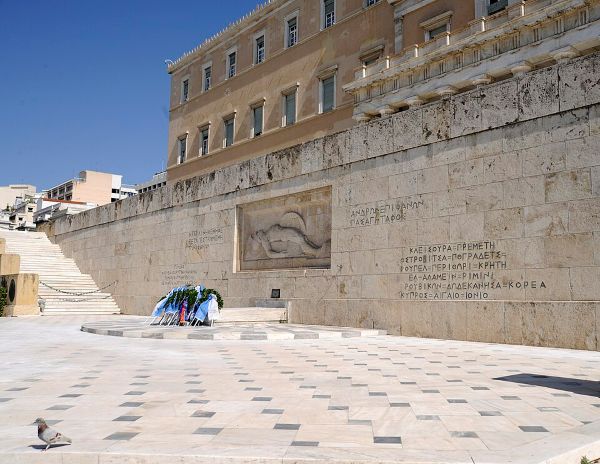
The conservative government of Greece has announced plans to ban protests at the Tomb of the Unknown Soldier, a prominent monument situated outside Parliament in Athens that has historically served as a venue for demonstrations.
Opposition parties have accused Prime Minister Kyriakos Mitsotakis of fostering intolerance and exacerbating societal divisions. In light of this, the government has proposed an amendment to existing legislation concerning the monument, which has sparked a vigorous debate in Parliament. Four opposition parties contend that the amendment is unconstitutional and infringes upon the rights of free expression, while the left-wing Syriza party has called for protests in response.
This area has recently gained significance as a site of remembrance for the relatives of victims of Greece’s deadliest train crash, which occurred in February 2023 in Tempi, central Greece, and resulted in 57 fatalities, primarily involving students. Panos Ruci, who lost his son Denis in the tragedy, has engaged in a 23-day hunger strike at the memorial, demanding exhumation of his son’s body for further examination.
The proposed amendment would permit visitors to the monument but would explicitly prohibit protests or modifications to the area, with penalties for violators potentially including fines or imprisonment. A makeshift memorial for the victims has been established, with their names painted in red on the ground.
The crash has highlighted significant shortcomings in Greece’s railway system and has prompted widespread anti-government protests. Critics have accused the authorities of neglecting to take responsibility, as allegations of a cover-up regarding the train’s cargo have emerged. A trial for 36 individuals charged in connection with the incident is scheduled to commence in March 2026, underscoring the ongoing political ramifications of this disaster.
The government maintains that the Tomb is a national monument deserving of protection. Spokesman Pavlos Marinakis has indicated that the purpose of the amendment is to foster respect for the site. At the same time, opposition parties interpret it as a countermeasure to the protests linked to the Tempi disaster.
