
Germany’s president has described the conflict in Iran as a serious misstep that contravenes international law. Frank-Walter Steinmeier has expressed significant concerns regarding the strain this situation has placed on Germany’s relationship with its most critical post-war ally, the United States, particularly in light of US President Donald Trump‘s foreign policy decisions.
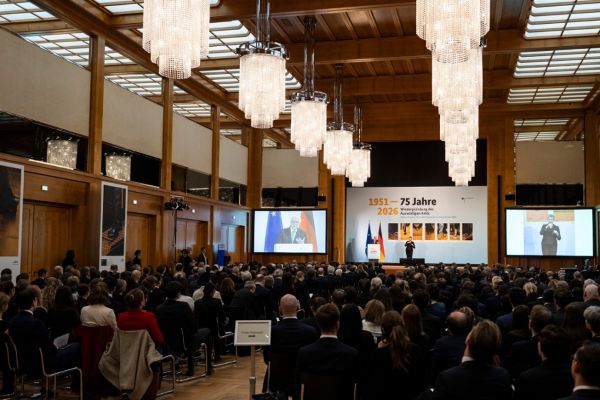
In an address at the foreign ministry on 24 March to mark the 75th anniversary of the Federal Foreign Office, Federal President Steinmeier called for a modern foreign policy that combines military strength, diplomacy and European unity. He highlighted that in an increasingly uncertain world, a rules‑based order remains indispensable. The president, who holds a largely ceremonial role, adopted a notably more critical stance than Chancellor Friedrich Merz, who has approached the conflict’s legality with greater caution.
“Our foreign policy does not become more convincing simply because we refrain from labelling a breach of international law as such,” the president stated. He emphasised the importance of addressing the consequences of the war in Iran, asserting that it is contrary to international law. President Steinmeier also expressed scepticism regarding claims of an imminent threat to US targets, describing the war as both unnecessary and politically damaging.
“Our foreign policy does not become more persuasive when we do not designate a violation of international law as such. We have already had to deal with this in the Gaza War and we have to deal with it in the Iran War, too. This war is a violation of international law – there is little doubt about that. It is also a politically fatal error, and what I find most frustrating is that it is an avoidable and unnecessary war if its goal was to stop Iran on the path to a nuclear bomb.”
The German president emphasised that the Russian invasion of Ukraine and the second term of Donald Trump profoundly shifted the relations between Europe, Russia and the US.
“Just as I believe our relationship with Russia can never return to what it was before 24 February 2022, I think we cannot turn back the clock on the transatlantic relationship to where it was prior to 20 January 2025. The rift is too deep, and the trust that has been lost in American great-power politics is too great – not only among Allies, but around the world. Even a future US Government will not simply be able to restart relations where they once stood in the days of the ‘friendly hegemon’ and its guarantees for a liberal international order,” the president said.
He highlighted the necessity for Germany to learn from its experience in reducing “excessive dependencies” on Russia and to apply those lessons to its relationship with the United States, particularly regarding defence and technology, which are essential to national power.
Germany is stressing the need for alternatives to US tech dominance. In August 2025, China surpassed the US and became Germany’s largest trading partner, with trade exceeding €163 billion.
President Steinmeier expressed solidarity with Cuba, stating that “solidarity cannot be blockaded” and highlighting the absence of fear regarding imperialism or major technology companies.
He suggested the Pentagon-Anthropic disagreement on AI safety could be a wake-up call for Europe to leverage its talent and ethical standards.
