
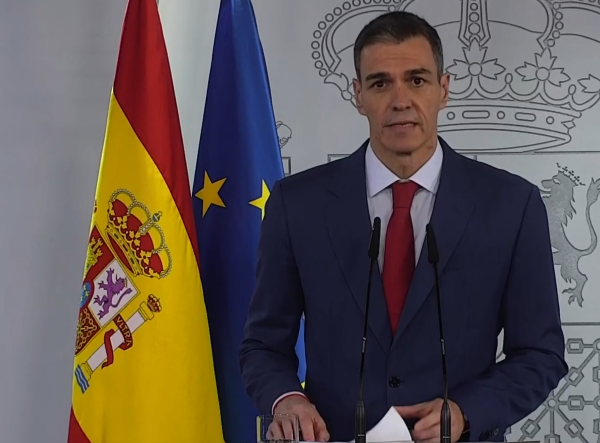
Spain’s Prime Minister, Pedro Sánchez, once again criticised the military actions of the US and Israel in Iran. On Wednesday, he stood firm against trade threats from Washington and warned that the conflict in the Middle East risked playing” Russian roulette” with millions of lives.
“We are not going to be complicit in something that is harmful to the world and contradicts our values and interests, just out of fear of reprisals from anyone,” Sánchez stated in a televised address.
On Tuesday, US President Donald Trump threatened to eliminate US trade with Madrid due to Madrid’s refusal to allow the US to use joint military bases in the country for attacks on Iran. Sánchez, who is Europe’s last major progressive leader, has called the US and Israeli attacks “unjust” and “dangerous” military interventions.
However, it remains unclear how Trump would cut off trade with Spain, given that Spain is a member of the European Union, which negotiates trade for all 27 member states.
When asked during an interview with CNBC whether a trade embargo against Spain would be feasible, US Treasury Secretary Scott Bessent stated on Wednesday that it would be a “combination effort.”
He didn’t provide further explanation but asserted that Spain’s denial of the US use of its bases during the recent attack on Iran endangered American lives. “Anything that slows our ability to engage and effectively prosecute this war puts American lives at risk,” Bessent remarked, adding, “The Spanish put American lives at risk.”
On Wednesday, Sánchez expressed concern that the attacks on Iran could lead to another costly military quagmire in the Middle East, akin to previous American interventions in Iraq and Afghanistan. “In short, the position of the government of Spain can be summarised in four words,” Sánchez said. “No to the war,” Sánchez affirmed.
The European Union has expressed its commitment to safeguarding its interests and stabilising its trade relationship with the United States, following a trade agreement reached last year amid significant economic uncertainty associated with Trump’s tariff policies. European Commission spokesperson Olof Gill stated, “We stand in full solidarity with all member states and their citizens, and through our common trade policy, we are prepared to take necessary action to protect EU interests.”
Following Spain’s decision to deny US access to its military bases, Trump commented on Tuesday, “We could use their base if we wish,” referencing the Rota and Morón installations in southern Spain, which are shared with the US but operate under Spanish command. He added, “We could just fly in and use it. No one is going to stop us, but we do not have to.”
This recent rhetoric from Washington reflects the President’s continued approach of leveraging the threat of tariffs and trade embargoes as a form of reprisal.
Spain has not engaged in direct communication with the US following Trump’s criticisms, as Economy Minister Carlos Cuerpo indicated on Wednesday. He remarked, “I want to send a message of calm,” during an interview with Spanish radio station Cadena Ser. “Aside from those comments by Trump, there have not been any additional actions taken by the US”
Major Spanish business organisations have raised concerns about potential trade implications, emphasising the US as a key partner both economically and politically. The Spanish business chambers CEOE, CEPYME, and ATA stated, “We trust that our trade relations will ultimately remain unaffected.”
A report released by Spain’s central bank last year concluded that the country’s economy, the fourth-largest in Europe, is relatively shielded from the impacts of Trump’s tariffs compared to the EU average. Spain’s exports and imports with the US accounted for 4.4% of its gross domestic product (GDP), compared with the EU’s overall trade with the US, which accounted for 10.1%. Exports of Spanish goods to the US accounted for 1% of Spain’s GDP, totalling €16 billion, making the US Spain’s sixth-largest export market. Noteworthy exports to the US include pharmaceutical products, olive oil, refined gas, and electrical transformers, according to the Observatory of Economic Complexity.
Spain’s position on the Iran conflict has complicated its already critical relationship with the Trump administration. Prime Minister Pedro Sánchez has been a vocal critic of Israel’s actions in Gaza and faced Trump’s discontent last year when Spain opted out of NATO’s commitment to increase defence expenditure by member states to 5% of GDP. The Spanish government justified its decision by stating that it could meet its defence needs with an expenditure of only 2.1% of GDP, a move that Trump openly criticised, threatening retaliatory tariffs in response.
This article used information from The Associated Press.
