
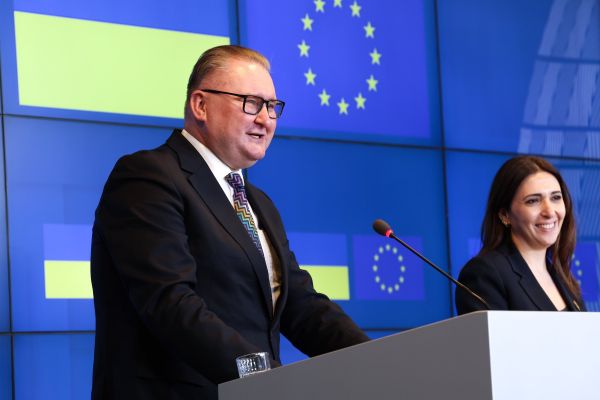
On Monday, Ukraine officially commenced negotiations for EU membership, initiating a process that requires the government to implement extensive political reforms while addressing the ongoing conflict with Russia. Ukrainian Deputy Prime Minister Taras Kachka participated in an intergovernmental conference in Luxembourg to initiate discussions aimed at aligning Kyiv with the bloc’s laws, standards, and values.
Deputy Prime Minister Kachka emphasised the importance of unity in the face of external threats, stating, “Aggression against Ukraine and threats against Europe are a consistent policy of Russia. Therefore, we must remain united and pursue a faster, more comprehensive accession to the European Union.” Ukraine perceives EU membership as a crucial security guarantee for a stable future following the resolution of the conflict.
While membership in the NATO military alliance would provide stronger assurance, the Trump administration considers this prospect unfeasible, and many other countries have expressed caution about Ukraine’s NATO membership amid the ongoing war.
Moldova has also officially initiated its membership discussions. Russia has a longstanding interest in maintaining Moldova within its sphere of influence, and last year, Moscow faced accusations of a disinformation campaign, facilitated by artificial intelligence, during its electoral process.
EU values and principles come first
Countries aiming to join the EU must complete negotiations in 35 policy areas, a process that can take years. At a meeting, five key chapters were opened, focusing on core EU values such as the rule of law and fundamental rights. These chapters include judiciary and fundamental rights, justice, freedom and security, public procurement, and statistics and financial control.
This is particularly important for some EU countries concerned about Ukraine’s commitment to fighting corruption. Recently, Ukrainian President Volodymyr Zelenskyy‘s former chief of staff was named a suspect in a major graft investigation, but Zelenskyy himself was not implicated.
Several European countries are pushing for Ukraine to join the EU quickly, as they see it as crucial for Europe’s security and have been supporting its armed forces. Last month, German Chancellor Friedrich Merz suggested offering Ukraine “associate membership” to revive discussions aimed at ending the war with Russia.
While countries like France and the Netherlands have proposed faster integration without full membership rights, EU officials insist on a merit-based process leading to full membership. Finland’s Foreign Minister Elina Valtonen stressed that completing reforms is essential, emphasising that Ukrainians seek freedom, democracy, and a transparent market economy free from corruption.
Prevent Orbán-like situations
Hungary significantly delayed Ukraine’s accession process under former Prime Minister Viktor Orbán, who was Russia’s strongest ally in Europe. Following his recent electoral loss, concerns remain about the influence of a single government wielding veto power over EU decisions. The European Commission had frozen billions in funds for Hungary due to democratic backsliding during Orbán’s tenure.
Swedish Foreign Minister Maria Malmer Stenergard emphasised the need for the EU to prioritise countries genuinely willing to collaborate and to prevent similar situations in the future.
This article used information from The Associated Press.
