
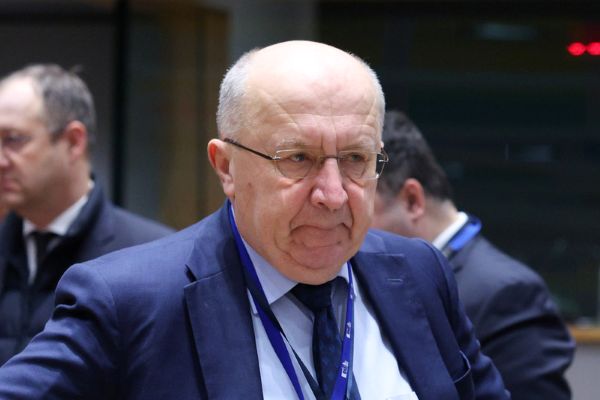
The European Union stands ready to provide security support for Greenland, contingent upon a formal request from Denmark, stated Andrius Kubilius, the European Commissioner for Defence and Space, on Monday. He expressed concern that a US military takeover of Greenland would effectively lead to the dissolution of NATO as we know it. Commissioner Kubilius underscored that the current NATO structure would be fundamentally altered in such an event.
US Donald Trump has argued that the US should acquire Greenland, an autonomous territory of Denmark, to prevent Russian or Chinese occupation of this strategically important Arctic region. As Greenland and Denmark have said that Greenland is not for sale, Trump and his entourage threaten to take the island by force.
“I agree with the Danish prime minister that it will be the end of NATO, but also among people it will be also very, very negative,” Commissioner Kubilius told Reuters at the Folk och Försvar security conference in Sweden.
He stated that such actions would have a “very deep negative impact on the people and our transatlantic relations.” While Kubilius did not believe a US military invasion was likely, he noted that Article 42.7 of the EU Treaty requires member states to assist Denmark in the event of military aggression. The response would depend on Denmark’s actions, but member states are obligated to provide support.
Kubilius questioned the logic of forcefully occupying Greenland, warning it could harm U.S.-European relations across various sectors. He asked, “Who will recognise that occupation?” and highlighted that Americans could face significant trade repercussions as a result.
Kubilius stated that the EU could enhance security in Greenland if Denmark requests it, possibly by deploying troops and establishing military infrastructure, such as warships and anti-drone systems.
He emphasised that Europe must build its military capabilities, regardless of US support. A US withdrawal from NATO would be challenging, as Europe would need to prepare for independent defence. “NATO, as it exists now, will not continue,” he said, highlighting the importance of adapting NATO structures to support a European defence pillar.
Speaking at the conference, Kubilius noted that the new US administration had officially asked European partners to be ready to take on all responsibility for the conventional defence of Europe. That is why, from the very beginning of the Commission’s mandate, the EU launched the Defence Readiness 2030 agenda, he emphasised.
“Because we understood that Europe is under pressure from defence challenges. And that we need to go for a ‘big bang’ in defence,” Kubilius added.
However, “At that time, there was no United States National Security Strategy, no Venezuela and no threats to Greenland. Now it’s even more clear that we need to build Europe’s Independence, as the Commission President repeated during the whole last year,” highlighted the commissioner.
The EU Defence commissioner noted that this idea is not very new and reminded that “Commission President Juncker, President Macron, Chancellor Merkel were speaking very similar words 10 years ago, after the Russian occupation of Crimea: That Europe must be more independent and autonomous. That we must overcome industrial fragmentation and that we must have interoperability. And even that we need to have a European Army.”
However, “it didn’t materialise, he said. And, “Now is the time to deliver.”
He agreed with Chancellor Merz’s recent comment that “the times of ‘Pax Americana’ are over.
Kubilius asserted that Defence Independence involves being ready for defence within NATO while reducing American presence in Europe. The uncertainty of the transatlantic partnership demands our determination.
