
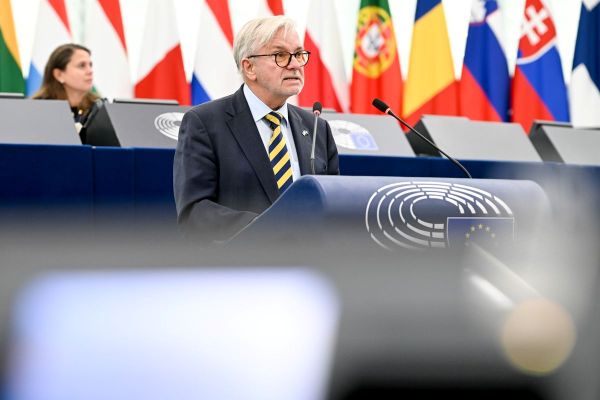
On Wednesday, Members of the European Parliament (MEPs) debated advancing Ukraine’s integration into the European Union, with consideration of the EU’s strategic interests. In its evaluation of Ukraine’s progress on the reforms necessary for its EU membership application, the Parliament supported the opening of the first fundamental cluster of accession negotiations, scheduled for June 2026, and expressed hope for the timely initiation of subsequent clusters.
However, a substantial portion of the discussion centred on commemorating the Ukrainian Insurgent Army (UPA), a point of contention between Poland and Ukraine. Polish MEPs underscored that commemorating the UPA does not align with the European values Ukraine is required to uphold as it seeks EU membership. They called for including this matter in the resolution.
The resolution was adopted with 460 votes in favour, 136 against, and 59 abstentions. The Parliament reaffirmed the importance of a constructive dialogue to advance Ukraine’s European integration, while also taking into account the EU’s strategic interests. MEPs urged EU member states to remain mindful of the dynamics present in accession countries, particularly in light of Russia’s efforts to undermine public support for EU membership, and to prioritise the future security of both Ukraine and the European continent.
“Since Ukraine’s European path started in 2014, the country has changed profoundly for the better. Russia’s war of aggression has even accelerated this process. A lot still has to be done, for instance, to meet the requirements of the fundamentals cluster. Continuation of judicial reforms and the unhindered work of the anti-corruption institutions remain key to advancing along the accession path and meeting citizens’ expectations”, said rapporteur Michael Gahler (EPP, Germany).
Ukraine’s efforts recognised
The report recognises Ukraine’s commendable efforts to reinforce its democratic institutions and uphold the separation of powers during a time of conflict. MEPs expressed their appreciation for Ukraine’s advancements in judicial reform and the ongoing battle against corruption, while emphasising the necessity for continued progress in these pivotal areas.
Establishing a strict rule of law is critical, as it will enhance transparency and accountability during reconstruction and economic recovery, thereby fostering a more favourable investment climate and strengthening trust with international partners.
In relation to upcoming elections, the report highlights the importance of allowing adequate time to ensure that the requisite standards and conditions for free and fair elections are fulfilled once martial law is lifted. MEPs oppose the pressure exerted by the US administration on Ukraine to conduct elections while the conflict with Russia persists. Civic Coalition MEP Andrzej Halicki (EPP, Poland) said that Ukrainians are seeking a European future for their nation. This vision aligns with the EU’s aspirations for Ukraine. He underscored that this objective demands decisive action, particularly reforms grounded in the rule of law and a genuine commitment to combating corruption.
Furthermore, the report welcomes the G7 leaders’ June 2026 statement on Ukraine, stressing the importance of supporting Ukraine’s momentum on the battlefield and intensifying pressure on the Russian war economy. MEPs also acknowledged the first payment of €3.2 billion under the Ukraine Support Loan and urged predictable EU multiannual financial support for Ukraine to help cover its recovery and defence costs, without the uncertainty of annual funding.
MEPs call for good neighbourly relations
Regarding the renaming of an elite military unit of the Ukrainian Armed Forces after the heroes of the Ukrainian Insurgent Army, MEPs regret the disregard for Polish sensitivities and grief and consider that this decision undermines neighbourly relations, calling for de-escalation and renewed efforts in good faith towards reconciliation. For Poland, despite its fight against the Stalinist regime, the UPA committed genocide against Polish minorities in parts of Ukraine.
Halicki highlighted that “It is also essential to respect common European values. We cannot glorify within the Community those who based (…) their activities on the fight against minorities, including genocidal actions.” “If we recall this fact as the European Parliament, we do so to reiterate one message: ‘You choose your future, but if you want to be in the Community, you must respect its values,” Halicki emphasised. “Not a single euro can be spent on these units bearing the names of criminals responsible for genocide.“
Michał Dworczyk (ECR, Poland), MEP for the Law and Justice party (PiS), said in the debate that the reforms implemented by Ukraine to align with European standards should be appreciated. However, he emphasised that European integration also means adherence to the fundamental values on which the EU is built, including historical truth and respect for victims. “Therefore, we found the decision to name an elite unit of the Ukrainian Armed Forces after the Heroes of the UPA, a formation responsible for the murder of approximately 100,000 civilians, mainly Polish women and children, as absolutely unacceptable,“ he noted.
Krzysztof Śmiszek (The Left, Poland) appealed to the Ukrainian and Polish authorities to resolve the dispute. “Good relations between our countries are fundamental to Europe’s security. Otherwise, we will have to continue this debate in the future, but in Russian,“ he emphasised.
Michał Kobosko (Independent) emphasised that the most painful historical experiences, such as the UPA crimes committed against Polish civilians, exist and cannot be ignored. Without working through them, we will not go anywhere further.
