
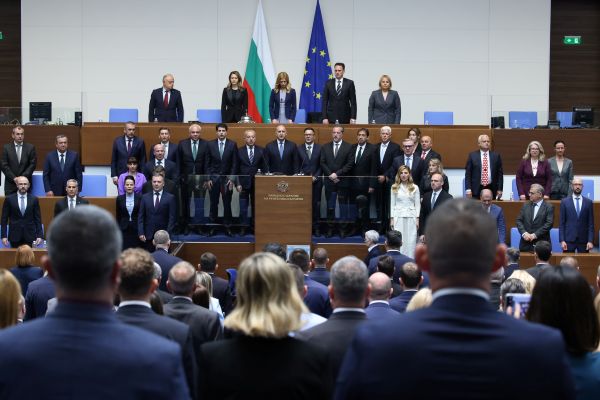
On Friday, the Parliament of Bulgaria formally ratified the appointment of Rumen Radev as the new Prime Minister, aiming to address ongoing political instability and promote economic development within the European Union member state. In his address to lawmakers, Radev, a 62-year-old former president, acknowledged the significant challenges that lie ahead: “We have no illusions about the crises and trials facing the government, which will soon be seeking your support – including rising prices, budgetary concerns, necessary reforms, a severe global energy crisis, and escalating conflicts.”
The parliamentary vote concluded with 124 members voting in favour, 70 against, and 36 abstaining. The overwhelming support, with 122 votes, came from the Progressive Bulgaria party. In contrast, the Democratic Bulgaria party (21 members), the Movement for Rights and Freedoms (21 members), Continue the Change (16 members), and the extremist Vazrazhdane (12 members) opposed the appointment. The 36 members of GERB-UDF abstained. Radev’s Progressive Bulgaria party previously achieved a significant victory in the 19 April parliamentary elections, securing a comfortable majority with 131 seats in the 240-seat legislature.
Rumen Radev, leader of Progressive Bulgaria, addressed MPs before the vote, highlighting the new government’s priorities. He stressed that achieving these goals will depend on effective cooperation between the government and the National Assembly. Key objectives include modernising the country and ensuring the security and well-being of Bulgarian citizens.
President Radev has established a government comprised of individuals with whom he has built strong working relationships over the years, along with distinguished experts in their respective fields. Galab Donev was appointed as Deputy Prime Minister and Minister of Finance, having previously served as caretaker prime minister in two successive governments. He also served as Chief of Staff to President Radev from 2023 to 2026.
The cabinet features prominent professionals, including Alexander Poulev, Deputy Prime Minister and Minister of Economy, Investments, and Industry, who boasts an extensive international career in the banking sector. Additional key figures in the government include Prof. Dr Georgi Valchev, Rector of Sofia University, Velislava Petrova, Minister of Foreign Affairs, and Katya Ivkova, Minister of Health, among others.
In January, Radev resigned from his ceremonial role as president, months before the end of his second term, to run for prime minister. This shift followed the collapse of Bulgaria’s conservative government in December amid large anti-corruption protests led mainly by young people. Radev gained popularity by opposing the entrenched mafia and their connections to politicians, pledging to eliminate the corrupt governance model.
Will Radev’s pro-Russian views prevail?
A former fighter pilot, Radev holds a Master of Strategic Studies from the U.S. Air War College and previously served as commander of the Bulgarian air force. His supporters are divided between those hoping he will tackle corruption and those who share his Eurosceptic and pro-Russia views.
Radev’s pro-Russian stance has raised concerns regarding Bulgaria’s position within European policymaking. Nonetheless, several political analysts anticipate that his future approach will remain moderate, particularly in contrast to that of former Hungarian Prime Minister Viktor Orbán. This expectation is largely influenced by Bulgaria’s substantial dependence on European funding.
“He will more likely seek to dilute Sofia’s support for Kyiv, for which Bulgaria is a key supplier of ammunition, and push for the resumption of Russian oil and gas imports, prioritising lower-cost energy supplies,” Florence Thiéry, an analyst at the Credendo insurance group, said in written comments.
“Despite these positions,” she added, “Bulgaria’s full accession to the Schengen Area and its recent adoption of the euro are expected to support continuity in foreign policy, making a reversal of its Euro-Atlantic stance unlikely.”
The new prime minister congratulated leaders from the EU member states. “Congratulations to Rumen Radev on becoming Prime Minister of Bulgaria. At a time of profound geopolitical change, we have a strong agenda to work on. From security and defence to jobs, competitiveness and energy independence. Together we move forward, for Bulgaria and for Europe,” posted on X European Commission President Ursula von der Leyen.
This article used information from The Associated Press.
