
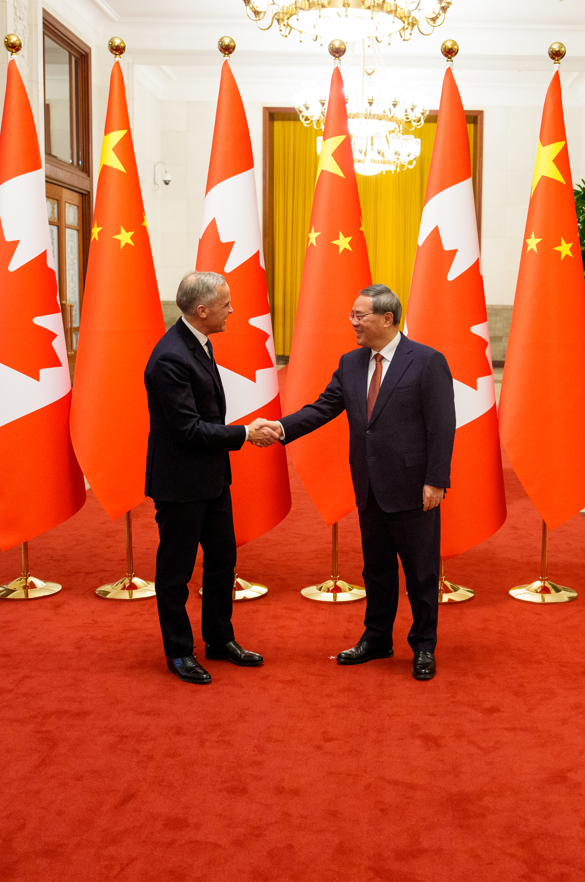
On his inaugural visit to China, Prime Minister Mark Carney stated on Thursday that Canada and China are entering a new era of diplomatic relations. Having assumed office ten months ago, Prime Minister Carney is focused on repairing the relationship between the two countries, which has experienced several challenges, including Canada’s 2018 apprehension of a senior Chinese technology executive and the imposition of 100% tariffs on electric vehicles manufactured in China.
During his visit, Prime Minister Carney met with Chinese Premier Li Qiang, who acknowledged the positive shift in bilateral relations. A meeting with President Xi Jinping is scheduled for Friday.
The Canadian government’s initiative to strengthen ties with China is further necessitated by US President Donald Trump‘s increased import tariffs. Presently, over 75% of Canada’s exports are directed to the United States, and Prime Minister Carney has set an ambitious goal to reduce this dependency by doubling exports to other nations within the next decade.
On Thursday, Prime Minister Carney met with several leading Chinese enterprises, including the prominent e-commerce company Alibaba, the state-owned China National Petroleum Corporation, and CATL, a leading producer of electric vehicle batteries.
“We’re ready to build a new partnership — one that builds on the best of our past, and responds to the challenges of today,” Carney posted on X after he arrived in Beijing on Wednesday night.
On the heels of the United States’ decision, Canada has announced the implementation of tariffs of 100% on electric vehicles (EVs) imported from China, as well as a 25% tariff on steel and aluminium products, effective in 2024 under the previous administration of Prime Minister Justin Trudeau, succeeded by Mark Carney. In an immediate response, China has imposed 100% tariffs on Canadian canola oil and meal, and 25% tariffs on pork and seafood imports. Further, China implemented a 75.8% tariff on canola seeds in August of last year. These measures have led an industry group to assert that the tariffs have effectively barred Canadian canola exports from the Chinese market.
China is leveraging these tariffs, along with other diplomatic pressures on allies such as Canada, to encourage a more independent foreign policy. The Chinese government has consistently accused the US of coordinating efforts with its allies to marginalise China, particularly under the former Biden administration.
The relationship between Canada and China was notably strained in late 2018 when Canadian authorities detained Meng Wanzhou, the chief financial officer of Huawei Technologies, at the request of the United States, which sought her extradition on multiple charges. In retaliation, Chinese authorities detained two Canadian citizens on espionage charges, sparking a prolonged period of diplomatic tension lasting over two years.
During a recent trip, Canadian Foreign Minister Anita Anand told her Chinese counterpart, Wang Yi, that the Prime Minister is eager to set a direction for enhancing bilateral relations and to resume dialogue across various sectors, as noted in a statement from the Chinese Foreign Ministry. Wang described this visit by Carney as a pivotal moment, with expectations of opening new avenues for cooperation between the two countries.
This article used information from The Associated Press.
