
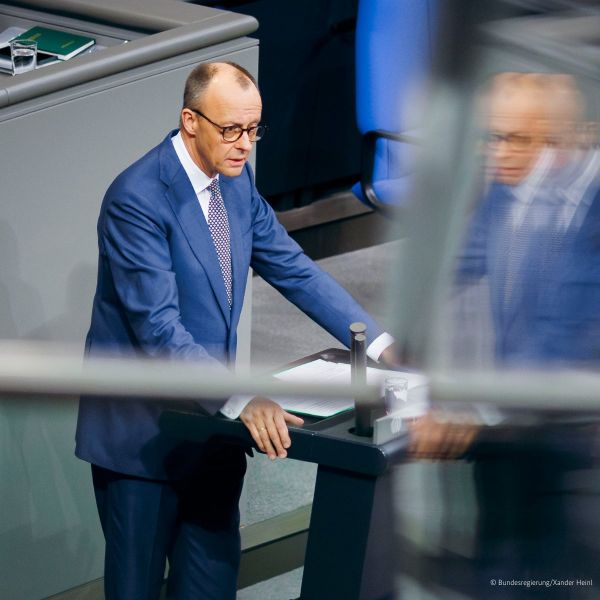
German Chancellor Friedrich Merz, speaking at the Bundestag today, praised the European Union, describing it as an “alternative to imperialism and autocracy” that is capable of forming strategic partnerships in an era of escalating competition among major global powers. He highlighted the enduring significance of NATO, indicating that Europe will enhance its defence initiatives while maintaining a commitment to equal collaboration with the United States, rather than as a subordinate ally.
Moreover, Chancellor Merz aligned himself with other European leaders in rejecting US President Donald Trump‘s assertion that troops from European NATO countries did not actively engage in the conflict in Afghanistan. His remarks to the German parliament regarding foreign policy followed a recent development in which President Trump withdrew a threat to impose new tariffs on Germany and seven additional European nations, because they oppose US plans to annex Greenland, a semi-autonomous territory of Denmark that is both a NATO ally and an EU member.
“We are seeing increasingly clearly in the last few weeks that a world of great powers is beginning to form,” Merz said. “A harsh wind is blowing in this world, and we will be feeling it for the foreseeable future.”
But that also opens opportunities for Europe, he said, as democracies with open and growing markets “seek what we have to offer them, namely partnerships on the basis of mutual respect, trust and reliability.”
“We should not underestimate how attractive this European model can be for new partners and new alliances,“ Merz told lawmakers. “We are also a normative alternative to imperialism and autocracy in the world.”
Chancellor Merz underscored the importance of unity within the sometimes divided 27-member European Union, noting that the bloc demonstrated its capacity for swift action just last week. “We reached a consensus that we would not allow ourselves to be intimidated by tariff threats,“ he stated.
He further stated that Europe must “learn the language of power politics“ to establish its presence in an evolving global landscape. This entails taking on greater responsibility for its security, striving for enhanced “technological independence,“ and fostering economic growth.
Merz is a strong proponent of the EU pursuing additional trade agreements, including one with South America’s Mercosur bloc and a recently established agreement with India. While seeking new partnerships, he emphasised the necessity of preserving existing alliances.
“It is evident for us, and for me personally, that we must not recklessly jeopardise our current alliances,” he remarked, adding that “transatlantic trust is a value that remains significant today.” He affirmed a commitment to strengthening NATO, stating that “we will consistently extend our hand of cooperation to the United States of America.”
“Simultaneously, the foundation of this guiding principle remains… as democracies, we are partners and allies, not subordinates,“ he emphasised.
Merz also acknowledged the sacrifices made by German troops, with 59 lives lost and well over 100 wounded during Germany’s nearly 20-year deployment in Afghanistan. While he did not specifically reference a recent interview in which the US President expressed uncertainty about the support of other NATO nations, he firmly asserted, “We will not permit this deployment, which we undertook in the interest of our ally, the United States of America, to be disparaged or diminished today.”
This article used information from The Associated Press.
