
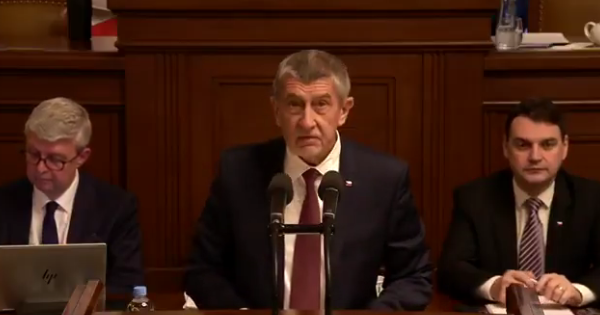
The new government of the Czech Republic, led by Prime Minister Andrej Babiš from the far-right ANO (YES) movement (a member of the Patriots for Europe (PfE)), has successfully passed a mandatory confidence vote in the lower house of Parliament. This vote, which concluded with 108 in favour and 91 against, is a requirement for all new administrations seeking to establish their authority to govern.
The government’s proposed agenda signals a shift away from support for Ukraine and a rejection of several key European Union policies. The debate took place in the Parliament, which has 200 seats.
Babiš, who previously served as prime minister from 2017 to 2021, has formed a coalition following the October elections, uniting with two smaller far-right parties: the Freedom and Direct Democracy (SPD), a party characterised by its anti-migrant stance and affiliated with the right wing extremist Europe of Sovereign Nations Group in the European Parliament, and the Motorists for Themselves party, which is also part of PfE. These parties align with Russian President Vladimir Putin’s foreign policy and support U.S. President Donald Trump. Collectively, they constitute a 16-member Cabinet.
The recent political resurgence of Babiš is expected to significantly reshape the nation’s foreign and domestic policies. In contrast to the previous pro-Western administration, Babiš has declined to provide financial aid to Ukraine and has refused guarantees for EU loans to the country engaged in resisting the Russian invasion. This positions him in alignment with other far-right prime ministers, such as Viktor Orbán of Hungary and Robert Fico of Slovakia.
Nevertheless, his administration does not intend to abandon a Czech initiative that successfully secured approximately 1.8 million critical artillery shells for Ukraine last year from markets outside the EU, contingent upon the Czechs managing the initiative without financial contributions.
Additionally, his coalition partner, the SPD, is in favour of the Czech Republic’s exit from the EU and NATO, advocating also for the expulsion of most of the 380,000 Ukrainian refugees currently residing in the country. Meanwhile, the Motorists, who oversee the environment and foreign ministries, have rejected the EU Green Deal and proposed reviving the coal industry.
This article used information from The Associated Press.
