
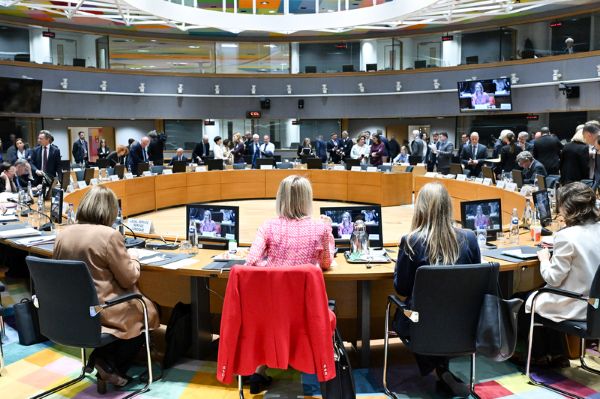
On Monday, the European Union reached a unanimous decision to implement new sanctions targeting the leaders of the Palestinian militant group Hamas and the Israeli settler movement, as reported by diplomats. This action was prompted by escalating concerns regarding the humanitarian crisis in Gaza amid the ongoing Israel-Hamas conflict.
During the meeting in Brussels, the foreign ministers of the 27-member bloc refrained from endorsing more stringent economic measures against the Israeli government, a request made by certain European nations. While a political agreement was reached, further discussions will be necessary to identify the specific organisations and individuals subject to the sanctions. A committee will be tasked with finalising the draft list.
Kaja Kallas, the EU’s foreign policy chief, commented on social media that the ministers recognised the imperative for accountability regarding extremism and violence. She noted, “It was high time we moved from deadlock to delivery.”
The European Union (EU) has not released a draft list of targeted individuals and organisations. Still, Haaretz reported that it may include settler groups such as Amana, Nachala, Hashomer Yosh, and Regavim, along with leaders such as Daniella Weiss, Meir Deutsch, and Avichai Suissa.
Daniella Weiss, often called the “godmother” of the Israeli settler movement, expressed confusion about the sanctions, calling them “ridiculous” and stating they won’t deter the movement. Regavim viewed the sanctions as “a badge of honour” and pledged to continue their efforts for governance and sovereignty.
Israel’s far-right government reacted defiantly, with Foreign Minister Gideon Saar labelling the sanctions “arbitrary and political.” He affirmed the government’s commitment to the right of Jews to settle in their homeland, a position supported by key figures such as Finance Minister Bezalel Smotrich and Cabinet minister Itamar Ben-Gvir.
French Foreign Minister Jean-Noël Barrot announced sanctions against Hamas leaders and individuals within the Israeli settler movement in the occupied West Bank. He emphasised that “serious and intolerable acts must cease immediately,” referring to Hamas as responsible for the worst antisemitic massacre in history since the Holocaust, which claimed 51 French lives.
As violence in the occupied West Bank escalates, Palestinians and rights groups report increasing killings and displacement of communities. The UN has recorded at least 40 Palestinian deaths this year, including a record 11 by settlers.
Irish Foreign Minister Helen McEntee stated that the EU cannot remain passive amidst rising violence and breaches of international law. The Israeli human rights group Peace Now called this decision a prompt for the Israeli public to acknowledge the ongoing reality of control and settlement in the occupied territories.
The EU’s unanimous vote followed the ousting of Hungarian Prime Minister Viktor Orbán, who had been in power for 16 years and consistently vetoed sanctions against Israeli settlers in the West Bank. His defeat in the April election by Péter Magyar allowed the EU to agree on new sanctions.
Martin Konečný from the European Middle East Project stated that the decision confirms Orbán was blocking these measures alone. This could signal a shift in the EU’s policy towards Israel, as criticism of Benjamin Netanyahu‘s government has led countries like Spain, Ireland, and the Netherlands to pursue penalties. Luxembourg’s Foreign Minister Xavier Bettel emphasised the need for action.
However, the EU diplomats could not agree on stronger measures, such as banning products from Israeli settlements or suspending a key trade agreement. Hugh Lovatt of the European Council on Foreign Relations criticised the sanctions’ limited scope. At the same time, Claudio Francavilla of Human Rights Watch called them “a step in the right direction,” but stressed that more is needed to ensure compliance with international law.
Italian Foreign Minister Antonio Tajani mentioned needing more time to evaluate a proposal to exclude West Bank settlers from EU markets, while Dutch Foreign Minister Tom Berendsen noted that individual nations could take action if Brussels stalls. Spanish Foreign Minister José Manuel Albares Bueno called for a vote to clarify support for measures against Israeli settlements.
This article used information from The Associated Press.
