
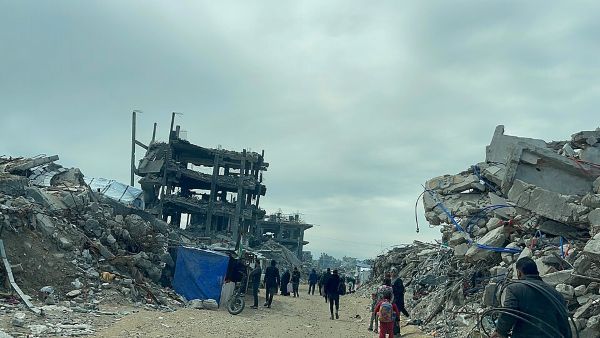
On Monday, representatives from over 60 nations convened in Brussels for discussions with Palestinian Prime Minister Mohamed Mustafa regarding stability, security, and long-term peace in Israel, the West Bank, and Gaza. This meeting comes at a time when global attention remains largely focused on the ongoing crises in Iran and Lebanon.
Belgian Foreign Minister Maxime Prévot emphasised that persistent attacks in the West Bank and the continued devastation in Gaza have significantly reduced the viability of a two-state solution. He co-hosted the meeting with Kaja Kallas, the European Union’s top diplomat. Also in attendance was Nikolay Mladenov, the director of the Board of Peace established by US President Donald Trump.
“We observe without naivety that the two-state solution is being made more difficult by the day,” Prévot said. “But Belgium and many European and Arab partners continue to believe that this remains the only realistic path to a lasting peace, for Israelis, for Palestinians and for the stability of the entire region.”
Palestinians in the West Bank have expressed concern that Israel is leveraging the ongoing conflict with Iran to strengthen its control over the region. Reports indicate an increase in attacks by settlers, alongside the Israeli military’s imposition of additional wartime movement restrictions under the guise of security.
During remarks made in Brussels on Monday, Mustafa emphasised the need for Gaza to establish “one state, one government, one law, and one goal.” He also advocated for the “gradual and responsible disarmament of all armed groups” as well as a complete withdrawal of Israeli forces from Gaza.
“Our common objective of achieving one security structure under the legitimate authority should guide the effective coordination between the International Stabilisation Force, the Palestinian Authority, security institutions and other international actors. Security must not be fragmented,” he said.
The EU is the largest donor to the Palestinian Authority, whose 90-year-old President Mahmoud Abbas has been ruling from Ramallah for two decades. Although the EU prefers engaging through the United Nations rather than joining the Board of Peace directly, it is eager to maintain a diplomatic role in the volatile region across the Mediterranean.
Outrage over the humanitarian crisis in Gaza has prompted many EU leaders to condemn Israel’s actions and pressure Prime Minister Benjamin Netanyahu. With the recent election defeat of Hungarian Prime Minister Viktor Orbán, a Netanyahu ally, there may now be enough political support for stronger measures against Israel, such as targeted sanctions on settlers or the suspension of ties.
Hungarian election winner Péter Magyar has indicated he will seek “pragmatic relations” with Israel while rejoining the International Criminal Court (ICC), which has issued an arrest warrant for Netanyahu, defied by Orbán during Netanyahu’s visit in 2025. Magyar may also abandon Orbán’s veto against EU actions regarding Israel.
Spanish Prime Minister Pedro Sánchez aims to end the long-standing EU Association Agreement with Israel, citing violations during military campaigns in Gaza. Spain plans to propose this termination at an upcoming meeting of EU foreign ministers. However, despite strong criticism from Spain, Ireland, and the Netherlands, joint EU action against Israel has struggled to gain traction.
“We have nothing against the people of Israel; quite the contrary,” Sánchez said in a post on X on Sunday. “But a Government that violates international law and, therefore, the principles and values of the EU cannot be our partner.”
This article used information from The Associated Press.
