
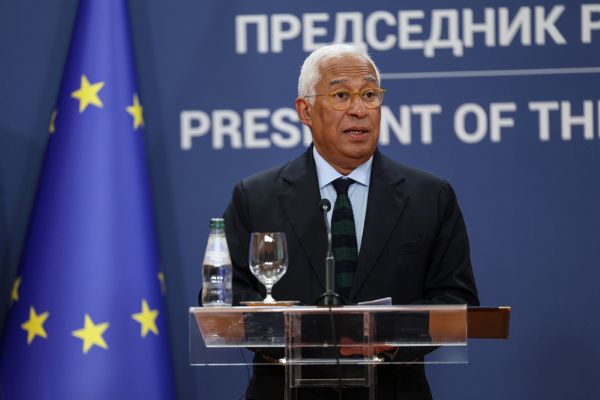
The European Union is set to explore new strategies to expedite the membership process for six Western Balkan candidate countries during an upcoming summit, according to European Council President António Costa. The countries—Albania, Bosnia and Herzegovina, Kosovo, North Macedonia, Serbia, and Montenegro—have been seeking EU membership for several years but have yet to complete the requisite merit-based evaluation.
In light of rising concerns about Russia and China’s influence in the region, the EU has recently focused on encouraging reforms in these candidate states. During a press conference in Belgrade, the capital of Serbia, President Costa emphasised the importance of building trust, stating, “If you want to build trust, we cannot create a feeling of frustration” regarding the perceived slow progress toward membership.
The summit is scheduled to take place on Friday in Tivat, a coastal town in Montenegro, and will bring together prominent European leaders and officials from candidate countries. Each country is at a different stage of the accession process, with Montenegro and Albania currently further along. To progress, candidate countries must align their legislation with EU standards across 35 policy areas, commonly referred to as “chapters,” encompassing domains from judicial standards to agricultural regulations. Approval from all 27 EU member states is necessary before any chapter can be opened or closed.
Moreover, the EU has underscored the need for Serbia and Kosovo to normalise their relations for their membership applications to move forward. Kosovo declared its independence in 2008, following a tumultuous period during which it was a Serbian province until NATO’s intervention in 1999 concluded a conflict involving Serbian government forces and ethnic Albanian separatists. Notably, Serbia does not recognise Kosovo’s independence.
President Costa remarked that European leaders will discuss with their Western Balkan counterparts how to enhance methodologies to achieve faster, more effective progress. He affirmed that “enlargement is not a utopia; it is a tangible possibility in the coming years,” underscoring the urgent need for collective effort.
In his comments, President Costa concluded his pre-summit tour of the Western Balkan candidate nations before proceeding to Montenegro. He advised Serbian President Aleksandar Vucic that his administration must intensify democratic reforms and align its foreign policy with the EU’s to advance its membership process. Serbia has been cautioned that failure to address issues of democratic integrity, particularly concerning the judiciary, could result in the loss of approximately €1.5 billion in EU funds. Improvements in media freedom and conditions for free and fair elections have also been strongly encouraged.
In addition to the Western Balkan nations, Ukraine and Moldova are pursuing EU membership. To date, Serbia remains the only European nation that has not imposed sanctions on Russia in response to the ongoing conflict in Ukraine and maintains amicable relations with Moscow as well as with China.
As President Costa noted, “We are eager and prepared to do more. However, it is important to clarify that the pace of progress depends on Serbia’s own commitment.”
The situation in Serbia remains complex, as President Vucic has faced ongoing protests led by youth movements, which began in November 2024 following a tragic train station accident resulting in the loss of 16 lives. On Thursday, he assured the public of his renewed dedication to advancing reforms to keep Serbia on the path toward EU integration.
Additionally, Vucic is heading to Tivat following Montenegro’s decision to restrict the entry of 87 Serbian nationals due to security concerns. These individuals reportedly possessed communication equipment and displayed banners reading “Serbia wins,” a slogan frequently used during President Vucic’s public appearances. The specific reasons for their travel to Montenegro remain unclear.
This article used information from The Associated Press.
