
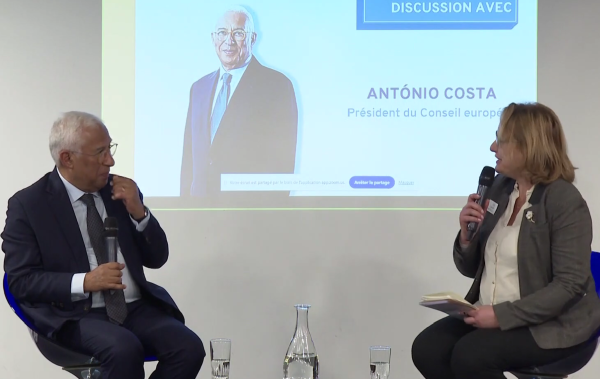
European Council President António Costa expressed concern on Monday about potential US interference in European affairs. He reaffirmed that it is the prerogative of European citizens to determine which political parties should govern their nations. His remarks were a response to the Trump administration’s national security strategy published on Friday, which characterises European allies as weak and appears to lend support to far-right political movements.
While Costa acknowledged the positive aspect of the plan, recognising European nations as allies, he emphasised that “allies do not threaten to interfere in the domestic political choices of their partners.”
“What we can’t accept is the threat of interference in European political life. The United States cannot replace European citizens in choosing what the good or the bad parties are,“ he said in Paris at the Jacques Delors Institute, a think tank.
The strategy presents a critical perspective on European policies regarding free speech and migration. The document suggests that US allies in Europe are facing significant challenges that could lead to what is described as “civilisational erasure,“ raising concerns about their long-term reliability as partners of the United States.
Costa, who chairs the summits of the 27 EU national leaders, emphasised that Europe’s history has demonstrated the inseparable connection between freedom of speech and freedom of information. He further cautioned that the preservation of free speech is jeopardised if the information rights of citizens are compromised for the benefit of technology oligarchs in the United States.
This security strategy marks the first initiative from the administration since President Donald Trump resumed office in January. It diverges sharply from the policies of President Joe Biden‘s Democratic administration, which focused on revitalising US alliances. This strategy emerges as the United States seeks to conclude Russia’s nearly four-year conflict in Ukraine, a situation the national security strategy identifies as vital to American interests. Furthermore, the document articulates a desire to enhance the US relationship with Russia after years in which Moscow was regarded as a global pariah, emphasising that resolving the conflict is crucial to “reestablishing strategic stability with Russia.“
Kremlin spokesman Dmitry Peskov has stated that the document “absolutely corresponds to our vision.“ Throughout the conflict, Russia has sought to create divisions among NATO allies, particularly between the United States and Ukraine’s primary supporters in Europe.
“If we read closely the part about Ukraine, we can understand why Moscow shares this vision,“ Costa said. “The objective in this strategy is not a fair and durable peace. It’s only (about) the end of hostilities, and the stability of relations with Russia.“
“Everyone wants stable relations with Russia,“ he added, but “we can’t have stable relations with Russia when Russia remains a threat to our security.”
“What I see is that there are so many people trying to undermine Europe,” noted EU Council President. “Why? Because the EU is strong. And we are working to make it even stronger. We have taken bold steps to build the Europe of defence and enhance our strategic autonomy. We have stood by Ukraine’s side, as its first and most steadfast supporter, since the start of the war. We have developed and strengthened our network of world partners, based on fair trade, shared prosperity and the defence of the rules based international order.”
Top EU officials and intelligence officers have warned that if Russia defeats Ukraine, it could be in a position to launch an attack elsewhere in Europe in three to five years.
This article used information from The Associated Press.
