
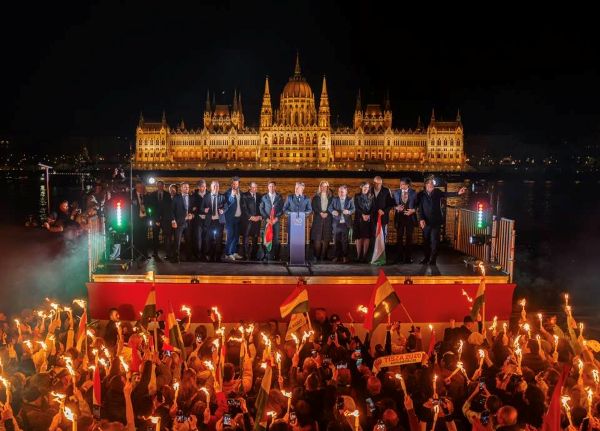
European Union officials are scheduled to meet on Friday in Budapest with representatives from Péter Magyar‘s team, following his victory in Hungary’s recent elections. The agenda will address significant matters, including a sizable loan for Ukraine and the potential release of approximately €17 billion in aid for Hungary, funds that have been frozen during the rule of outgoing Prime Minister Viktor Orbán.
While Magyar is set to take office in May, the European Union is keen to initiate discussions to facilitate a swift, productive partnership with the incoming government. European Commission spokesperson Paula Pinho spoke about this intention during a briefing in Brussels on Thursday.
“The clock is ticking for a number of topics,” said Pinho. The “preliminary talks” in Budapest before Magyar takes office are to “make sure that once the government is in place action can be taken, if appropriate, and that we do not waste any time.”
Billions frozen because of corruption
The European Union froze billions in funding to Hungary over concerns of corruption and democracy under Viktor Orbán’s 16-year rule. However, the EU and Hungary’s new leaders are keen to release the funds to help boost the struggling economy. European Commission President Ursula von der Leyen noted that “swift work” is needed to reform Hungary’s policies to unblock the funds.
“Restore the rule of law. Realign with our shared European values. And reform, to unlock the opportunities offered by European investments,” said the EU executive, who herself was often vilified by Orbán during his campaign.
Significant reforms for unblocking EU funds
Magyar, leader of the Tisza party, recently won a supermajority in parliament, enabling him to implement significant reforms. He announced that his government will focus on judicial independence, media and academic freedom, and anti-corruption measures to secure EU funding. In his first press conference after his victory on 12 April, he stated that Hungary is in a challenging financial situation and aims to reclaim funds that belong to the country.
Unlike his predecessor Orbán, who vetoed a previously agreed-upon €90-billion loan for Ukraine, Magyar committed to honouring the agreement. The funds include €10 billion in COVID recovery aid and €6.3 billion in cohesion support for struggling EU economies, with an urgency to access the COVID funds before they expire in August.
Hungary, a key net recipient of EU funds, has faced criticism for moving away from democratic norms. The European Commission had previously suspended funding due to concerns about democratic backsliding under Orbán. However, a year later, improvements led to the potential release of around €10.2 billion. As noted by Zsolt Darvas of the think tank Bruegel, Magyar has the opportunity to implement reforms to unlock these funds swiftly.
“All the legislative work can be done in a single day if there is a will from the Tisza party to do it,” told The Associated Press. “That’s relatively straightforward and not technically difficult.”
To improve the selection and powers of judges, Magyar can address setbacks related to the COVID funds deadline by following Poland and Portugal’s example of using a national development bank to distribute the funds.
Darvas pointed out that Hungary has already lost about €2 billion of the €16 billion due to a two-year suspension. Since 13 June, 2024, Hungary has been paying €1 million per day, in addition to a €200 million fine for failing to align its asylum processing with EU standards. By complying with EU laws while remaining largely closed to migration, Hungary could end these fines and create a more stable investment climate.
Hungary could also receive substantial funding by joining the EU’s €150 billion Security Action for Europe (SAFE) initiative, which aims to strengthen defence readiness. Thus far, 18 of the EU’s 27 nations have received low-interest defence loans, and Hungary is eligible for €16 billion in such loans. Combined with additional funding, this support would amount to about 15% of Hungary’s GDP, according to Jeremy Cliffe of the European Council on Foreign Relations.
This article used information from The Associated Press.
