
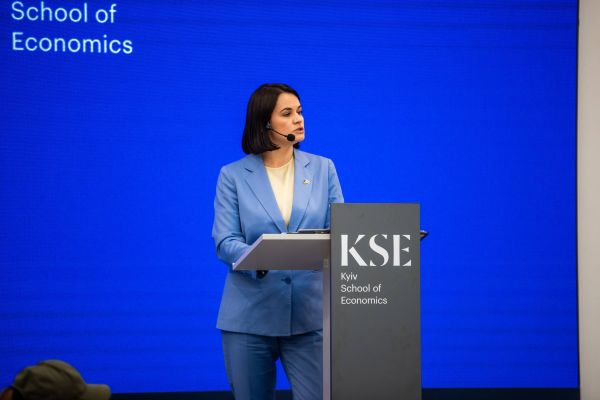
Belarus’ exiled opposition leader, Sviatlana Tsikhanouskaya, visited Kyiv on Monday, coinciding with the Ukrainian capital’s recovery efforts following Russia’s most significant missile attack of the year. Global leaders are carefully observing the level of support the Belarusian government may extend to Moscow in its ongoing invasion.
Recently, Russia and its ally Belarus conducted joint nuclear drills, raising concerns in the region. Ukrainian President Volodymyr Zelenskyy has expressed apprehension that Belarus could serve as a launchpad for Russia to initiate a new front in northern Ukraine. It is noteworthy that some Russian troops had entered Ukraine from Belarusian territory during the invasion that began on 24 February 2022.
Additionally, in a sign of escalating concern, French President Emmanuel Macron spoke by phone with Belarusian President Alexander Lukashenko on Sunday to discuss the situation in Ukraine; it was their first conversation since the invasion.
Russia threatens more ‘systemic strikes’
The Russian Foreign Ministry has stated that additional “systemic strikes” on Kyiv are expected. The ministry is advising foreign citizens, including diplomatic personnel, to vacate the city at their earliest convenience and has recommended that residents refrain from approaching military and government facilities. The ministry labelled Friday’s Ukrainian drone strike on a college dormitory in Starobilsk as “the final straw.” In response, Ukraine has asserted that its actions targeted only those facilities aiding Russia’s invasion.
Currently, the Russian military is engaged in a challenging and resource-intensive conflict along the 1,250-kilometre front line, which primarily traverses eastern and southern Ukraine. Kaja Kallas, the European Union’s foreign policy chief, remarked on social media that “Russia has reached a dead end on the battlefield, leading it to resort to terrorising Ukraine through deliberate strikes on urban centres.”
The availability of US-made air defence missiles has been compromised, particularly due to circumstances involving Iran, making it increasingly difficult for Ukraine to intercept Russian missile attacks. Concurrently, the United States’ efforts to facilitate a resolution to the ongoing conflict have encountered obstacles.
Belarus represents a severe threat
In a recent discussion, French President Emmanuel Macron explained to Belarusian President Alexander Lukashenko the potential risks of Belarus’s involvement in Russia’s military operations in Ukraine. Their discussion also addressed regional matters and the dynamics between Belarus and the European Union.
During her inaugural visit to Kyiv, Belarusian opposition leader Sviatlana Tsikhanouskaya remarked that Lukashenko’s regime is aware of the necessary steps to enhance relations with the European Union, yet has chosen not to act. She highlighted ongoing hybrid threats and the prevailing climate of fear in the region. Tsikhanouskaya emphasised that Ukraine is not only defending its sovereignty but also advocating for the freedom of all nations facing authoritarian rule.
Speeking at the Kyiv School of Economics, Tsikhanouskaya told students that “Today, Russia is trying to tighten its control over Belarus through military presence, nuclear weapons, and Russification. That is why a democratic Belarus must be part of Europe’s future security architecture.”
She added that “Only when Belarus is free from dictatorship and Russian control, with a government chosen in free and fair elections, will our country become a guarantor of peace instead of a source of threat.”
Ukrainian Foreign Minister Andrii Sybiha reiterated that Ukraine distinguishes between the Belarusian government and its citizens, expressing appreciation for the contributions of Belarusian volunteers and activists striving for liberty.
Lukashenko, who has maintained control over Belarus for over three decades, is reliant on Russia for essential support. In light of Western sanctions imposed due to human rights violations and Belarus’s collaboration with Russia, he has recently sought to improve relations with Western nations by releasing political prisoners in exchange for the easing of some US sanctions.
Russia attacks Ukraine with hypersonic missile
On Sunday, Russia bombarded Ukraine using its hypersonic Oreshnik ballistic missile, which can carry multiple warheads and travel up to ten times the speed of sound, evading air defences. President Volodymyr Zelenskyy reported that Ukrainian intelligence had received warnings from the US and European countries about the impending launch.
The attack resulted in two deaths and at least 91 injuries, according to Kyiv City Administration head Tymur Tkachenko. The assault damaged buildings throughout the city, including government offices, residential areas, schools, and a market.
Ukrainian Foreign Minister Sybiha led ambassadors from over 70 countries to the strike sites, urging the international community to increase pressure on Moscow and provide more air defence support to Ukraine.
This article used information from The Associated Press.
