
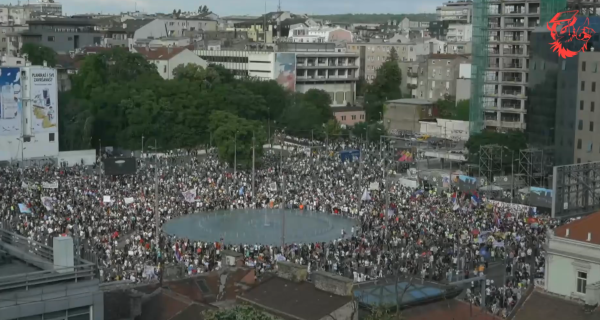
Tens of thousands participated in a rally on Saturday, organised by university students in Serbia, despite the government’s efforts to suppress mass demonstrations challenging the authoritarian governance of President Aleksandar Vucic (Vučić). Protesters converged in a central square in Belgrade, arriving from various directions, many carrying banners and wearing T-shirts bearing the motto “Students win,” a symbol of the youth movement.
Additionally, numerous vehicles travelled to Belgrade from other Serbian towns earlier in the day. Protester Maja Milas Markovic remarked on the unifying impact of the students’ energy, stating, “I truly believe that we have the right to live normally.”
The students have been at the forefront of a nationwide movement advocating against corruption, which arose in response to a tragic incident at a train station in northern Serbia in November 2024, resulting in the loss of 16 lives. These protests led to the resignation of then-Prime Minister Milos Vucevic; however, the government subsequently intensified its efforts to quell dissent.
During the rally on Saturday, the students reiterated their calls for early parliamentary elections and the establishment of the rule of law, accusing the government of engaging in corrupt practices and criminal activities.
Prosecutor Savovic: No uniform above the law
Prosecutor Bojana Savović addressed the crowd, stating, “A state where laws are selectively enforced ceases to be a state and becomes a mafia organisation.” She emphasised that “no uniform should be above the law” and that every excess of force or illegal behaviour must be subject to thorough investigation.
Savović remarked, “What we experience today—bombings and mafia confrontations—is not a state; it is anarchy.” She insisted, “The right to protest is constitutionally guaranteed, and the state must respond with protection, not force.”
She criticised prosecutors in leadership positions for prioritising the government over the law, highlighting the seriousness of the crisis. “The role of the prosecutor’s office is to uphold the law and maintain citizens’ trust,” she stated.
Savović concluded that students are demanding fundamental democratic rights, seeking justice and equal application of the law, and that resolving a political crisis requires truth and accountability.
Vucic’s regime intimidates protesters
Parliament Speaker Ana Brnabic characterised the recent student rally as lacking novelty, indicating that it did not present new demands or perspectives. According to police estimates, approximately 34,300 protesters participated in the rally, while Brnabic asserted that “democracy is flourishing” in Serbia.
In a related event, Serbia’s state railway company cancelled all train services to and from Belgrade on Saturday. This decision appears aimed at limiting the movement of individuals travelling from other Balkan regions to the capital.
Supporters of President Vucic convened in a park outside the Serbian presidency building, a location established before a significant anti-government demonstration last March, serving as a protective presence against protesters. The atmosphere included traditional folk music within a secured area, which was monitored by rows of riot police in full gear.
While the student rally concluded peacefully, there are valid concerns about potential confrontations with Vucic’s loyalist supporters, who have been known for their aggressive behaviour in previous protests. Vucic continues to face international criticism for his firm stance against demonstrators.
The youth movement’s demand for justice and rule of law resonates with many citizens disillusioned by decades of crisis. Students plan to challenge President Vucic in the upcoming elections, which he announced could be held between September and November. Vucic and pro-government media have labelled critics as foreign agents seeking to destabilise the country, further deepening political polarisation.
European institutions concerned about Serbia’s future
Michael O’Flaherty, the Council of Europe Commissioner for Human Rights, has issued a report this week expressing concerns regarding the Serbian government’s actions. He emphasised his commitment to closely monitoring the situation, highlighting reports that indicate police have been protecting unidentified and often masked individuals who are attacking journalists and protesters. O’Flaherty observed a deterioration in the overall human rights situation in Serbia since his previous visit in April 2025.
While Serbia is actively pursuing membership in the European Union, it continues to strengthen its ties with Russia and China. The EU’s top official for enlargement has cautioned that the democratic backsliding under President Vucic could potentially result in a loss of approximately €1.5 billion in EU funding for membership candidate countries.
This article used information from The Associated Press.
