
Hungarian legislation that prohibits LGBTQ+ content for minors has been determined to violate European Union law and breach a foundational treaty that guarantees respect for human rights and equality, as ruled by the European Court of Justice on Tuesday.
The court emphasised that Hungary’s law, enacted in 2021 by the nationalist-populist government led by then-Prime Minister Viktor Orbán, “stigmatises and marginalises” LGBTQ+ people and fails to adhere to the EU’s prohibition against discrimination based on sex or sexual orientation.
This controversial legislation restricts the display of content illustrating homosexuality or gender transition to minors and imposes stricter penalties for crimes of pedophilia.
The Hungarian government has asserted that its policies, including a more recent law and constitutional amendments that effectively prohibited the well-known Budapest Pride event, aim to protect children from what it refers to as “sexual propaganda.” However, critics have made comparisons between this law and Russia’s 2013 gay propaganda law, arguing that it conflates homosexuality with pedophilia.
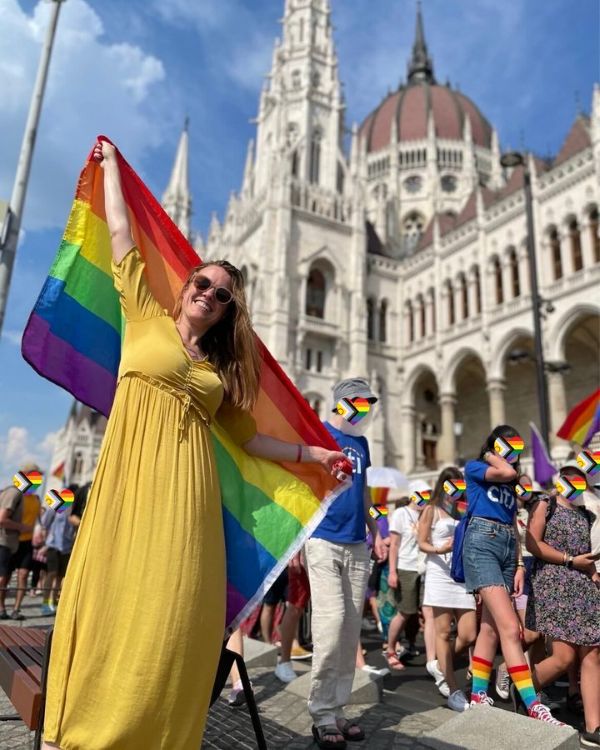
Notably, despite the governing restrictions, more than 100,000 people participated in the Budapest Pride march last year in defiance of the government’s ban. In its ruling, the Luxembourg-based court found that, for the first time in a case against one of the EU’s 27 member states, Hungary had violated Article 2 of the EU’s foundational treaty. This article outlines the values of respect for human dignity, freedom, democracy, equality, and the rule of law, as well as respect for human rights, including the rights of minority groups. Additionally, the court concluded that the law infringed upon EU services regulations and data protection laws.
The Orbán government suffered a significant defeat in the 12 April elections, in which the centre-right Tisza party, led by Péter Magyar, emerged victorious, effectively ending Orbán’s 16-year tenure in power. The new government is expected to assume office in mid-May and has committed to pursuing a more constructive approach to its relationship with the EU.
During the election campaign, Magyar exercised caution in engaging with the contentious debate surrounding LGBTQ+ rights. Nevertheless, in his victory speech on 12 April, he expressed a vision for Hungary as a nation “where no one is stigmatised for loving someone differently than the majority.”
Reacting to Tuesday’s ruling declaring Hungary’s law, which discriminates against people based on their sexual orientation and gender identity as contrary to the EU acquis, MEP Tineke Strik (Greens/EFA, NL), Parliament’s rapporteur for the Article 7 procedure for Hungary, stated:
“Today’s judgment is an unequivocal recognition of the stigmatisation, intimidation and rights violations that the LGBTIQ+ community in Hungary has suffered at the hands of the Orbán regime. It is now up to the new Hungarian government to ensure the implementation of this judgment and the genuine and full restoration of the rights of this community is front and centre in its plans to reinstate the rule of law. Anything less would render those reforms no longer credible. Today’s judgment also has ramifications beyond Hungary, as it clarifies that our values, enshrined in Article 2 of the EU Treaty, are not merely enforceable through political mechanisms, but also directly adjudicable before the Court. I therefore urge the Commission to continue to make use of this avenue whenever serious and systematic violations of the EUs fundamental values occur.”
This article used information from The Associated Press.
