
Poland is committed to taking an active role in nuclear security within a military framework, as emphasised by Prime Minister Donald Tusk during discussions regarding participation in the French nuclear deterrent system. He said that Poland aims to prepare for increasingly autonomous actions in this critical area in the future.
On Monday, French President Emmanuel Macron outlined plans for a new nuclear deterrent, proposing collaboration with European nations like Poland. He announced an increase in French warheads to enable European allies to participate in deterrence exercises.
Before a government meeting on Tuesday, Prime Minister Tusk informed that discussions concerning an “advanced nuclear deterrent system” with France were on the agenda. He noted that consultations are ongoing not only with France but also with other countries interested in this initiative, including Belgium, Denmark, Greece, the Netherlands, Germany, Sweden, and the United Kingdom.
Tusk stated that he would have the opportunity to further discuss this matter in March during the Nuclear Energy Summit in Paris, where he will engage with President Macron and other European partners. He affirmed, “Poland will not take a passive approach concerning nuclear security in a military context. We will collaborate with our allies, including France, which has extended a specific offer. As we enhance our own autonomous capabilities, we will also work to position Poland for the most independent actions possible in this domain.”
The proposed cooperation regarding the nuclear deterrent may include hosting French strategic air units in the specified countries, conducting joint military exercises, and demonstrating nuclear capabilities outside France.
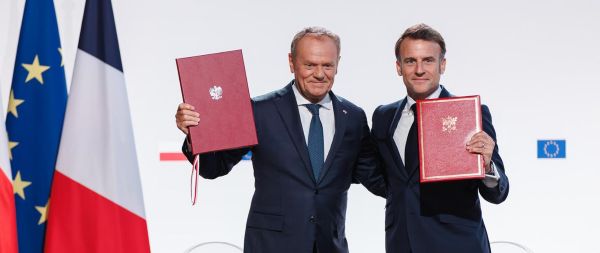
In May 2025, Prime Minister Donald Tusk and French President Emmanuel Macron formalised a significant treaty in Nancy that includes, among other provisions, mutual security guarantees for both Poland and France. This treaty includes a clause that provides for military support in the event of an attack on either nation. Historically, France had extended such commitments solely to Germany.
The Treaty on Enhanced Cooperation and Friendship also facilitates collaboration across various sectors, including defence, economy, agriculture, and scientific research. Therefore, this future cooperation within the framework of French nuclear deterrence is a logical progression arising from sustained government discussions and strategic actions.
