
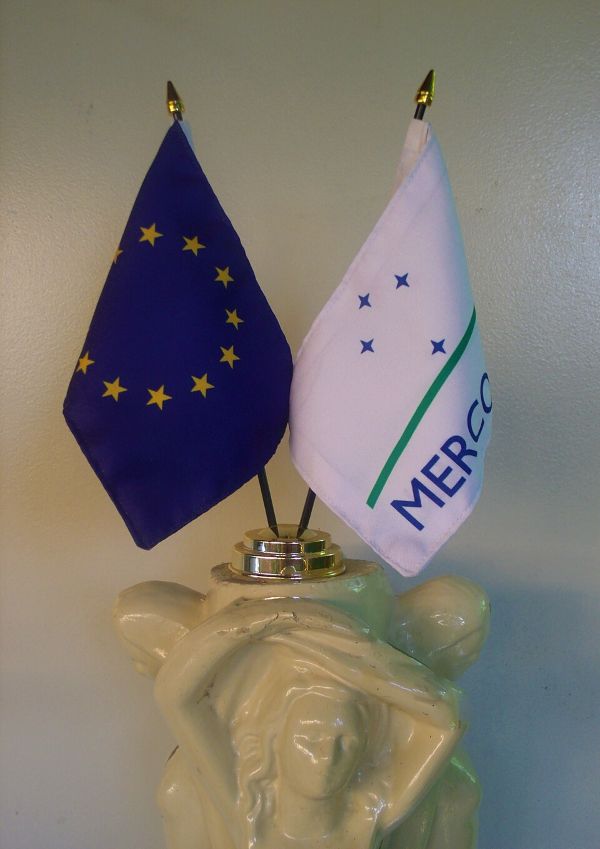
European Commission President Ursula von der Leyen announced on Friday her intention to commence the provisional implementation of a trade agreement with the Mercosur bloc of South American nations, despite the European Parliament’s lack of approval. This trans-Atlantic trade deal has the potential to establish one of the largest free trade zones globally, encompassing over 700 million individuals. Current trade between the two regions exceeds €110 billion and accounts for a quarter of global gross domestic product.
Nonetheless, the agreement has faced considerable criticism from Europe’s agricultural sector and environmental advocates, and it is expected to encounter significant opposition from members of the European Parliament. With this decision, President von der Leyen is effectively moving forward without the endorsement of these lawmakers.
“When they are ready, we are ready,” von der Leyen said, referring to the EU lawmakers without whose approval the agreement cannot be concluded. With backing from European leaders, she said the Commission will “provisionally implement the agreement” after Uruguay and Argentina ratified the EU-Mercosur trade deal on Thursday.
French President Emmanuel Macron strongly disapproved of the decision during a press conference in Paris.
″For France, it’s a surprise. A bad surprise,” he said. “And for the European Parliament, it’s bad manners.″
The French president emphasised his commitment to upholding the hard-won protections for farmers and public health during implementation. “We will be unwavering in our commitment to these regulations,” he stated. This will include enhanced surveillance of sensitive sectors, the inclusion of safeguard clauses and mirror clauses, particularly concerning pesticides, and the enforcement of stricter sanitary regulations for third countries.
″I will never defend a deal that is lax on what we import and tough on what we produce at home, because that is inconsistent with European consumers. It is criminal for European sovereignty,” Macron said.
The deal responds to global trade disruptions caused by US tariffs and China’s restrictions on critical minerals, leading the 27-nation EU to seek free trade agreements worldwide.
Supporters like Germany’s foreign minister, Johannes Wadephul, praised the Mercosur deal, stating it will benefit prosperity and growth across continents. Spain’s economy minister, Carlos Cuerpo, emphasised that this agreement is essential for Europe to remain independent and resilient in an uncertain world. Critics, including Macron, quickly condemned von der Leyen’s decision.
Implementing the trade deal immediately, without the court’s opinion and without MEPs’ consent, would undermine democratic processes, stated 171 environmental, labour, and agricultural groups from Europe and South America in an open letter. The letter described von der Leyen’s decision to implement the provisional measure as a “democratic scandal.”
“At a time when many in our society feel sidelined and are losing faith in political processes, opting for provisional application would be profoundly anti-democratic and would risk inflaming tensions within EU countries as well as between them,” the press release highlights.
Ursula von der Leyen is expected to dismiss any criticism, as she has done in the past, to move forward with a deal she believes is essential for the EU’s survival in an increasingly chaotic world. “This is about resilience, this is about growth, and it is about Europe shaping its own future,“ von der Leyen stated at a news conference where no questions were permitted.
“Our businesses, our workers, and our citizens will reap the benefits, and they should reap them as soon as possible,“ she added. “Mercosur embodies the spirit in which Europe is acting on the global scene.”
She acknowledged that the agreement can only be finalised with the European Parliament’s consent and that the Commission will work closely with EU institutions and stakeholders for a smooth process.
In January, lawmakers voted to challenge the deal in the European Court of Justice, which could delay it for years. Even without court or parliamentary obstacles, it may take months for the deal to take effect.
This article used information from The Associated Press.
