
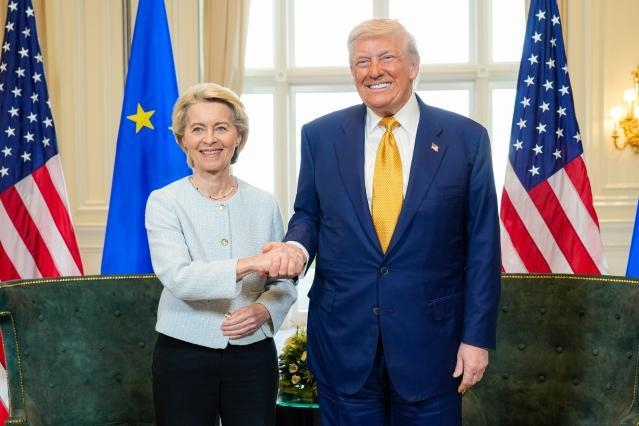
The European Union struck a new trade deal with the United States, avoiding the risk of higher tariffs but confirming a 15% export duty and a pledge for investments in the US, in a deal that received mixed reactions from heads of state across the bloc.
Under the new deal, the US will maintain a fixed 15% tariff on most EU exports – aluminium and steel will remain at the current 50% rate. Most European firms and politicians had hoped for a lower tariff or even a return to the 2.5% rate of last year, but were fearing the threatened 30% that Donald Trump announced last month.
“Today’s deal creates certainty in uncertain times. It delivers stability and predictability, for citizens and businesses on both sides of the Atlantic. This is a deal between the two largest economies in the world,” emphasised European Commission President Ursula von der Leyen.
In addition, the EU will make $750 billion in strategic purchases from the US, primarily in energy, and will also invest $600 billion in the country. Currently, it is unclear how both of these pledges will be fulfilled.
Reactions to the deal have been mixed, with companies happy to find some clarity going forward.
The car-making industry was the most jubilant, as it was the only sector that saw a decrease in import duty, from 27.5% to 15%. The relief from them was echoed by German Chancellor Friedrich Merz, who commented that “this agreement has succeeded in averting a trade conflict that would have hit the export-orientated German economy hard. This applies in particular to the automotive industry.”
Realising that the deal struck is not a very appealing one, Commissioner for Trade Maroš Šefčovič remarked that “a trade war may seem appealing to some, but it comes with serious consequences. With at least a 30% tariff, our transatlantic trade would effectively come to a halt, putting close to five million jobs” at risk. According to him, several industrial sectors welcomed the deal, and above all, they wanted to avoid further escalations.
Overall, the general reaction has been one of relief for clarity but sadness for the outcome, with higher overall tariffs and a sense of being forced by Donald Trump into a needless trade dispute. Swedish trade minister Benjamin Dousa said that “this agreement does not make anyone richer, but it may be the least bad alternative.” Similarly, his Irish counterpart, Simon Harris, said that “while Ireland regrets that the baseline tariff of 15% is included in the agreement, it is important that we now have more certainty on the foundations for the EU-US trade relationship.”
On a more sombre note, Danish Foreign Minister Lars Lokke Rasmussen remarked that “the trade conditions will not be as good as before, and it is not our choice, but a balance must be found that stabilises the situation and that both sides can live with.”
Also, French Prime Minister François Bayrou lamented the outcome, saying: “It is a sombre day when an alliance of free peoples, brought together to affirm their common values and to defend their common interests, resigns itself to submission.”
France has been the more sceptical about the deal and wants to see how the details of the investments and pledges will go. French industry minister Marc Ferracci believes that talks will continue for months to iron out the deal better. The level of uncertainty around the deal prompted Italian Prime Minister Giorgia Meloni to comment that “I consider it positive that there is an agreement, but if I don’t see the details I am not able to judge it in the best way.”
