
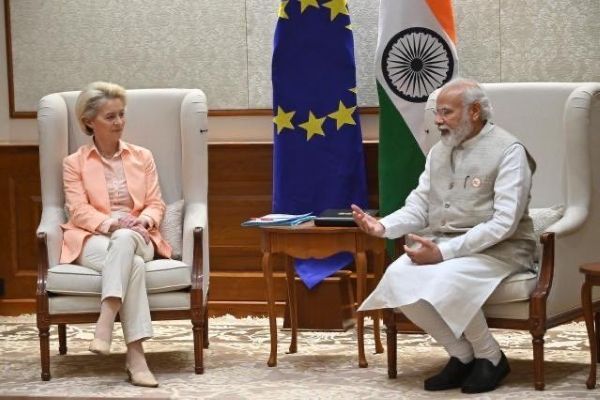
The European Union (EU) and India have successfully concluded negotiations on a long-awaited trade agreement, which will be formally announced on Tuesday, according to India’s trade secretary. Both parties regard this accord as a historic milestone, particularly in light of the challenges posed by strained relations with the United States.
This agreement will establish free trade in goods between the EU, comprising 27 member states, and India, together accounting for a quarter of global gross domestic product and a market encompassing 2 billion consumers. For the fiscal year ending in March 2025, trade between India and the EU is projected to reach $136.5 billion.
The formal signing of the agreement will occur after a legal review expected to take five to six months, according to Reuters, citing an informed Indian government official.
The new mega agreement will follow the EU’s recent agreement with Mercosur and previous agreements with Indonesia, Mexico, and Switzerland last year. Meanwhile, India has finalised trade agreements with Britain, New Zealand, and Oman.
Recent agreements focus on diversifying trade partnerships in response to shifting geopolitical dynamics, especially US policies. After nearly two decades of discussions, India is set to open its protected market—the world’s largest—to free trade with the European Union, its principal trading partner.
Following an agreement between India’s Prime Minister Narendra Modi and European Commission President Ursula von der Leyen to expedite negotiations, talks resumed in 2022 after a nine-year break. This momentum was influenced by tariffs imposed by the former US administration, including a 50% tariff on Indian goods.
Key issues during negotiations included automobiles and steel. The EU sought significant reductions in India’s import duties on cars, which can exceed 100%, while India pushed for relaxed EU restrictions on its steel exports. Reuters reported on Sunday that India plans to cut tariffs on EU cars to 40% from as high as 110%. Notably, sensitive agricultural and dairy products were excluded from these negotiations to protect millions of subsistence farmers in India.
