
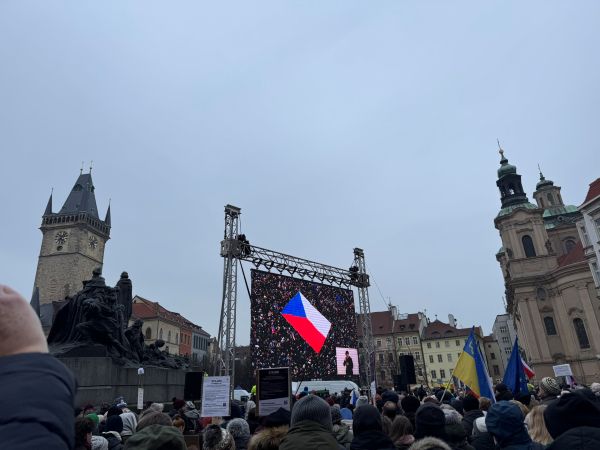
On 1 February 2026, tens of thousands of Czechs rallied in the capital and various cities across the country to support President Petr Pavel and the Czech Constitution, which are under threat from the far-right government of Andrej Babiš. The conflict arises from Pavel’s refusal to appoint a minister from the far-right Motorists for Themselves party led by Foreign Minister Petr Macinka.
Andrej Babiš, leader of the far-right ANO (YES) movement and a member of the Patriots for Europe (PfE), formed a coalition after the October elections with two smaller far-right parties: Freedom and Direct Democracy (SPD), known for its anti-migrant stance, affiliated with the right-wing extremist Europe of Sovereign Nations Group in the European Parliament, and the Motorists for Themselves party, also part of PfE. These three parties align with Russian President Vladimir Putin‘s foreign policy and support US President Donald Trump and his MAGA movement.
While the President of the Czech Republic has a primarily ceremonial role, he ratifies international agreements and Cabinet appointments. The President delayed Babiš’s appointment as Prime Minister until Babiš’s conflict-of-interest issue was resolved, but refused to appoint Filip Turek, the Honorary President of Motorists for Themselves, as the environmental Minister “due to ineligibility.”
Why Turek is not suitable for minister
Filip Turek has been associated with racism, hate speech, homophobia, and sexism after publications highlighted his Facebook posts promoting such views. While he has apologised for some of his content, he denied responsibility for others. Turek has also opposed the EU Green Deal, promoting ecophobic ideas, making him ineligible to serve as environmental minister of an EU member state.
Moreover, his past includes connections with neo-Nazis. During the 2024 European election campaign, photos surfaced showing him in a golden helmet with a symbol used by the disbanded Greek neo-Nazi party Golden Dawn, appearing to give a Nazi salute, and posing with a swastika-adorned candlestick. Turek, who claimed to be a collector of historical items, including an SS soldier’s knife, denied being a Nazi sympathiser.
However, the Czech police investigated his gestures but closed the case in November 2024 due to the statute of limitations. Additionally, old photos of him wearing a Luftwaffe helmet and Facebook comments from 2013 to 2018 surfaced.
Despite President Pavel’s refusal, the Motorists for Themselves returned, once again requesting that the President appoint Turek. When President Pavel declined, Foreign Minister Macinka sent him messages accusing him of violating the country’s Constitution and threatening that there would be consequences if he did not appoint his controversial associate.
The President’s response to the far-right threats
President Pavel responded that he viewed this as an attempt at blackmail.
“Foreign Minister Petr Macinka has been trying to influence my stance on the appointment of the proposed government member for some time now. Whether through communication with me, my colleagues, or advisors. So far, I have assessed all these attempts with leniency,” the President posted a message on X on 27 January.
“He has now delivered two text messages to me in the night hours via my advisor Petr Kolář – despite knowing the address of the Office of the President – containing information that I consider extraordinarily serious. Therefore, I have decided to publish them in full,” the President wrote.
President Pavel highlighted in his post that “I regard the words of the Foreign Minister in the text messages as an attempt at blackmail. I consider this unacceptable and, in our democratic conditions, utterly intolerable.”
“Moreover, the Minister states in the text that he has the support of the Prime Minister of the Czech Republic and the SPD party leader Tomio Okamura for his approach. If he truly has the Prime Minister’s support for his actions, then Petr Macinka’s statements are not only an illustration of the new government’s approach to sharing power in our constitutional order, but also proof that key issues of our foreign and security policy have become hostages to personal animosities and interests,” the President noted.
“If, however, he does not have the support of Andrej Babiš – and I believe he does not – then it is an illustration of the arbitrary and utterly irresponsible approach of the Motorists for Themselves party, which is not concerned with the interests of the Czech Republic and its citizens, but solely with fulfilling its own ambition to make a controversial figure a minister. At any cost,” the President said, announcing that he is planning to meet the far-right Prime Minister Andrej Babiš over the issue on Wednesday.
President Pavel emphasised that “Threats and blackmail against the President of the Republic by a government minister are utterly unacceptable in any democratic country. At the same time, I consider it important for citizens to see how their elected representatives, and in what manner, they represent their interests. Such behaviour can also damage the image and credibility of the Czech Republic abroad.”
“As for myself, I can say that intimidation does not work on me, and I will continue to be guided above all by the Constitution and the interests of the Czech Republic. I am submitting a complaint to the security apparatus and intend to forward the sent messages to lawyers for assessment of whether they constitute the factual elements of the criminal offense of blackmail,” the President concluded his message.
PM Babiš against key EU policies
Andrej Babiš, who previously served as Prime Minister from 2017 to 2021, is against the Czech Republic’s support for Ukraine and rejects several key European Union policies. His recent political resurgence is expected to influence both foreign and domestic policies within the nation significantly.
In contrast to the preceding pro-Western administration of Petr Fiala, Babiš has opted not to extend financial aid to Ukraine and has declined to provide guarantees for EU loans intended for the country amid its resistance to the Russian invasion. This stance aligns him with the other far-right leaders of the region, Viktor Orbán of Hungary and Robert Fico of Slovakia. This coalition intends to implement substantial changes to the foundations of the Czech Republic, potentially altering its democratic framework towards an authoritarian model.
