
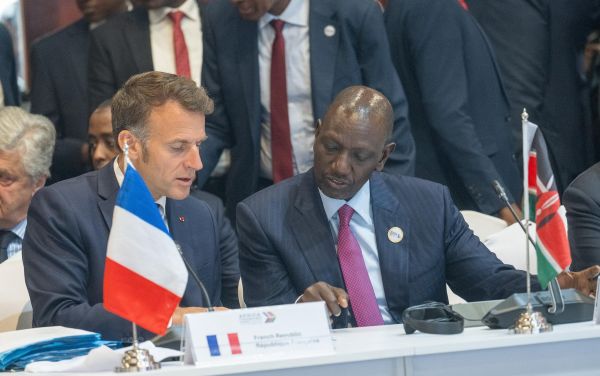
French President Emmanuel Macron is currently facing criticism following his intervention at the Africa Forward Summit in Kenya, where he asked the audience to remain silent during a panel discussion. Macron took to the stage to address attendees, calling it a “total lack of respect” and accusing them of disrupting the speakers, who included artists and young entrepreneurs.
Earlier in the summit, Macron had identified himself as a “Pan-Africanist” during a news conference. The event aims to redefine France’s relationship with Africa, transitioning from a historical role as a colonial power to what Paris characterises as a partnership of equals. On Tuesday, Macron announced a $27 billion investment in various sectors in Africa, including energy, artificial intelligence, and agriculture.
Footage of Macron’s impassioned plea for order gained widespread attention on social media, prompting a range of reactions, from support to criticism. Clearly frustrated by the noise, he stepped onto the stage and requested the microphone, asserting the need to “restore order.” Speaking in English, he called upon the audience to refrain from interrupting the speakers. While some members of the audience expressed approval of his intervention, others found it contentious.
Thierno Mbaye, a history student from Dakar, Senegal, remarked, “Just imagine what would happen if an African leader did the same thing in America or Europe,” adding that Macron’s approach resembled that of a schoolteacher reprimanding students.
Additionally, the incident drew comments in France, with Danièle Obono, a lawmaker for the France Unbowed party, stating on social media that Macron’s behaviour during his visits to the African continent seems reminiscent of a colonial mindset.
France in West Africa
The Africa Forward Summit is wrapped up on Tuesday with a big declaration that all 30 heads of state are expected to sign. This event comes at a time when France is facing some serious tension with its former colonies, especially in West Africa. For years, France has pursued a colonial policy called Françafrique, maintaining a large military presence in the region it once controlled.
After being called out repeatedly by leaders and opposition groups in West African countries for what they see as a belittling and heavy-handed approach, France has pulled out most of its troops, finishing the withdrawal from Senegal back in July.
Before the summit, President Macron stirred up controversy with his comment at a news conference alongside Kenyan President William Ruto, claiming, “We are the true Pan-Africanists.” He emphasised that Africa is a continent with a lot to build. This didn’t sit well, especially since Pan-Africanism is all about uniting Africans and getting rid of colonialism, and given France’s history, his words went viral, drawing lots of backlash.
Togolese human rights activist Farida Nabourema wrote an open letter saying, “Pan-Africanism is not a brand, Mr Macron, or just a diplomatic position. It’s a political philosophy that rejected everything France has said yes to for three centuries: slavery, colonialism, and neocolonialism.”
Beverly Ochieng, a senior analyst at Control Risks, said Macron appears to be trying to distance France from its diplomatic and military issues in West Africa by looking east. This could signal a change in France’s strategy as it seeks goodwill elsewhere. Ochieng raised questions about whether this new approach really means working together as equals or if it’s just talk.
The French presidency and Foreign Ministry haven’t commented yet. Still, Macron did say on Tuesday that France will respect the independence of African countries, stating, “Sovereignty and autonomy are shared, and your success is our success.”
Alioune Tine, founder of the Afrikajom Centre think tank, said Macron’s remark might also be a subtle jab at Russia, which has replaced France as the main security partner in some West African countries. “When Macron describes himself as the ‘true‘ pan-Africanist, it is also a subtle response to the pro-Russian pan-Africanist voices online, which French officials tend to view as inauthentic or politically manipulated,“ Tine said. He said relations between Western powers and African states are inherently paternalistic and France is no exception, but that Macron has shifted policy away from the colonial legacy through a more informal diplomatic style aimed at rebuilding trust.
According to an Ipsos survey conducted on behalf of the French Foreign Ministry in nine African countries ahead of the summit, 74% of respondents said they have a positive image of France. Support was highest in English-speaking countries and among respondents under 35. Macron, the first French president born after the colonial era, had pledged after his 2017 election that he would reset French relations with Africa.
This article used information from The Associated Press.
