
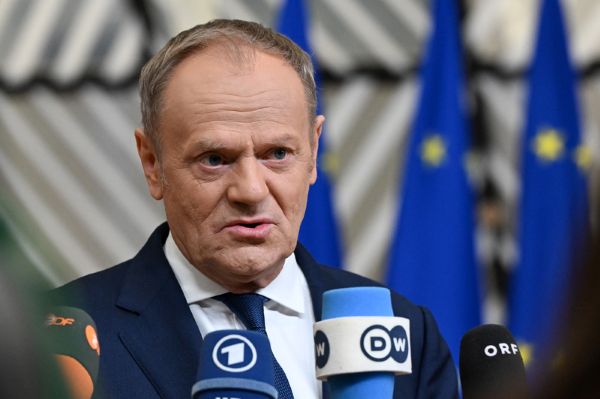
Polish Prime Minister Donald Tusk announced on Friday his commitment to exploring ways to access €43.7 billion in defence loans from the European Union, despite President Karol Nawrocki’s veto of the enabling legislation. Poland was poised to become the largest recipient of the EU’s €150 billion Security Action for Europe (SAFE) initiative, designed to enhance Europe’s defence posture amid diminishing US involvement in continental security. This loan will facilitate the swift acquisition of military equipment within Europe, with approximately 90% intended to benefit the Polish defence industry.
President Nawrocki, a nationalist politician and prominent opponent of Prime Minister Tusk, announced on Thursday that he would veto the legislation, citing concerns about its implications for national sovereignty. This development is particularly troubling given the current geopolitical climate. Many observers believe that President Nawrocki’s veto undermines Poland’s security interests, as SAFE represents a strategic opportunity for the nation. To date, the President has not provided substantial justification for his position.
Prime Minister Tusk has explained that the favourable financing conditions offered by SAFE are critical to strengthening Poland’s defence, particularly in light of perceived escalations in threats from Russia. Conversely, President Nawrocki argues that involvement in SAFE would lead to increased national debt and a dependency on Germany. To counter this, he has proposed a plan to utilise domestic resources, suggesting that funds generated by the National Bank of Poland—stemming from the market valuation of national gold and currency reserves—be allocated for defence purposes through a newly created fund.
Prime Minister Tusk has expressed scepticism regarding this alternative proposal, stating, “This bill lacks adequate funding—it introduces new bureaucratic processes and regulatory frameworks without addressing the core issue.”
He has characterised this alternative as impractical in the current context.
PiS disinformation efforts
Since he was elected President of the Polish Republic, Karol Nawrocki has undertaken actions that appear to undermine the Polish government’s efforts across various sectors. The nationalist Law and Justice party (PiS), which supports Nawrocki and shares his critical stance towards Tusk and the European Union, is strategically positioning itself for a return to power in the upcoming general elections scheduled for 11 November 2027. In pursuit of favourable support from the Trump administration, PiS has opted to boycott all government initiatives. The defence sector has recently become a focal point for both the President and PiS.
A comprehensive disinformation campaign was launched immediately after the government endorsed the SAFE programme. The presidential camp introduced a concept described as “Polish SAFE 0%,” which, according to the President and the President of the National Bank of Poland (NBP), would serve as an alternative to the EU SAFE programme. However, despite multiple requests, the government has yet to receive detailed information on the contributions the NBP would make to funding the Polish arms industry and national defence.
Key PiS representatives have disseminated misleading information about the SAFE and encouraged the President to veto the bill. For instance, former Prime Minister Mateusz Morawiecki has questioned PM Tusk about the existence of a solution that would not impose long-term debt on Poland—specifically the “SAFE 0%” proposal, which he claims would be “sovereign and free from foreign influences.”
In a post on X on 10 March, Dariusz Rosati, a former Minister of Foreign Affairs and former Member of the European Parliament, clarified that “there is no such thing as ‘SAFE zero percent.'” He explained that in every scenario, the NBP would need to print money, which could result in either costly reverse-repo operations to drain liquidity or increased inflation affecting the general public. Additionally, he noted that servicing SAFE debt typically constitutes only 1 per mille of GDP on average.
The President’s veto, in conjunction with PiS’s ongoing campaign, continues to polarise Poland’s political landscape. Furthermore, their persistent hostility towards Prime Minister Tusk and the European Union poses a significant risk to Poland’s security.
US interference undermines Polish security
“The United States has expressed concerns about how EU defense initiatives like Security Action for Europe and the European Defense Industry Program restrict market access for American companies,” Andrew Puzder, the US ambassador to the EU, and Matthew Whitaker, the US ambassador to NATO, argued in an opinion piece published in February by Politico Europe.
The two ambassadors characterised European programmes as undermining collective defence by limiting competition, stifling innovation, and depriving US companies of vital contracts. Moreover, US Ambassador to Poland Tom Rose has often expressed his views on the Polish government’s actions, suggesting measures to better align with US administration interests. He has also criticised the EU’s SAFE programme while advocating that Poland acquire military equipment from the United States.
Dariusz Rosati noted, “The ambassador has an insufferable habit of lecturing Polish authorities on matters of our internal policy.” He further pointed out that while promoting US purchases, Ambassador Rose does not mention that the United States is selling Abrams tanks and F-35s to Poland on dollar-denominated credit with annual interest rates ranging from 5% to 6%.
Rosati emphasised the importance of enhancing Europe’s defensive capabilities, particularly in light of the increasing unpredictability of American policy, which is a reality Europe is currently facing.
What next?
“Poland is in shock,” Tusk stated on Friday. “Citizens are questioning whether this circumstance reflects treason, lobbying influences, or simply a lack of common sense.” He noted that while the presidential veto will not impede the Polish government from utilising defence funds, it will undoubtedly complicate the process. “This will make it increasingly difficult, potentially slower, and will require considerably more effort to gain the necessary consensus among all stakeholders involved in this initiative,” he added.
A spokesperson for the European Commission affirmed on Friday that the EU remains committed to implementing the plans established with Poland “without delay.” An advance payment could be processed as early as April.
In light of Russia’s full-scale invasion of Ukraine in 2022, successive Polish governments have increased defence spending. However, the nationalist Nawrocki has adopted a more Eurosceptical stance and has fostered a more favourable relationship with the Trump administration, particularly now that a liberal government is in place in Poland. Nawrocki’s veto represents a critical error that may diminish Poland’s defence capabilities at a time when Russia poses a significant threat to the entire region, particularly to Poland.
This article used information from The Associated Press.
