
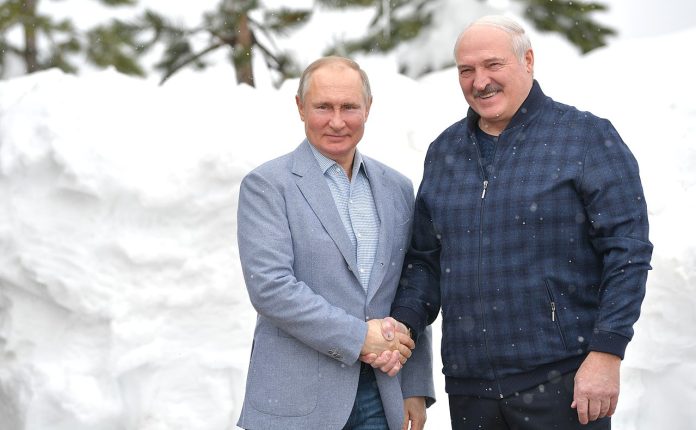
US President Donald Trump engaged the US in several direct contacts with Alexander Lukashenko, the dictator of Belarus and a key ally of Vladimir Putin, after taking office for a second term in the White House. Over the past year, Lukashenko has released hundreds of political prisoners as part of deals negotiated with the US. However, the human rights group Viasna estimates that nearly 900 political prisoners remain in Belarus. In addition, US-Belarus meetings avoided any discussion about human rights and basic freedoms in the last dictatorship of Europe.
Lukashenko has established a brutal regime in Belarus, which he has led for more than three decades. He has offered Belarusian territory to Russia for military bases, permitted Russia to use Belarus as a staging ground for its full-scale invasion of Ukraine in February 2022, and subsequently allowed the deployment of Russian tactical nuclear weapons in Belarus.
Belarus-North Korea cooperation
Belarusian dictator Alexander Lukashenko arrived in North Korea on 25 March for an official visit. During this trip, he will discuss bilateral relations with North Korean dictator Kim Jong Un. In recent years, Kim has also prioritised relations with Russia, contributing thousands of troops and large quantities of weapons to support the Russian invasion of Ukraine.
Belarusian state media indicated that the visit would focus on areas of mutual interest. Foreign Minister Maxim Ryzhenkov mentioned that the two sides are expected to sign a friendship and cooperation treaty, along with several other agreements. The visit marks Lukashenko’s first official trip to North Korea.
Trump’s diplomacy flirts with Lukashenko
US Special Envoy for Belarus, John Coale, revealed in a Financial Times interview on 23 March that the United States is considering inviting Alexander Lukashenko to meet with President Donald Trump at the White House or Mar-a-Lago. This potential visit represents a notable shift in Washington’s approach after years of isolation due to the regime’s crackdown on protests in 2020.
Coale’s recent trip to Belarus on 19 March led to the release of 250 political prisoners, which was part of a business strategy. Following this visit, the US eased sanctions on several Belarusian entities, including Belinvestbank and three potash firms.
Lukashenko confirmed on 20 March that the US proposed a “big deal” from Trump, stating, “I’m fine with this; tell Donald that I agree to work out this big deal.” The timing of Lukashenko’s potential visit remains unclear, as the two leaders have only spoken once during Trump’s second term, on 15 August 2025.
Coale noted that the decision on preconditions for a meeting lies with the president, expressing hope for the release of all remaining political prisoners in Belarus by the end of the year. He emphasised his good relationship with Lukashenko, stating, “We trust each other.”
A criminal regime
For many years, President Lukashenko has advocated for a “multi-vector” foreign policy, seeking to balance relationships between Russia and Western countries. However, this narrative effectively collapsed following the 2020 presidential election, which is widely perceived to have been won by opposition candidate Sviatlana Tsikhanouskaya. In response to the subsequent mass protests that erupted after Lukashenko refused to acknowledge the election results, the regime employed a brutal crackdown on dissent.
In February, former President Trump characterised his relationship with Lukashenko positively, noting that they have a good rapport and expressing his respect for the Belarusian dictator.
Nevertheless, Belarus is currently under investigation for alleged crimes against humanity—an issue that appears not to be of concern to Trump, his administration, or the members of the MAGA movement. It is important to note that the International Criminal Court (ICC) has issued arrest warrants for war crimes regarding two of Trump’s friends: Russian President Vladimir Putin and Israeli Prime Minister Benjamin Netanyahu. Anyway, Trump does not recognise the ICC’s authority.
Trump’s “Board of Peace“ and the February incident
Despite a foundation of trust and friendly relations, the US bureaucracy and the amateurism of the Trump administration jeopardised this “good“ relationship in February.
When Trump announced the creation of his “Board of Peace,“ he invited various leaders, including the Belarusian dictator. He also invited him to attend the board’s first meeting in February. Although the invitation was personally addressed to Lukashenko, he chose not to attend the meeting in person and sent Foreign Minister Maxim Ryzhenkov instead. This decision was expected, as Lukashenko does not participate in international forums in the West.
However, despite the timely submission of all necessary documents, the Belarusian delegation did not receive visas to attend the Peace Council meeting. The Belarusian Ministry of Foreign Affairs criticised this, questioning, “If even basic formalities aren’t respected, what ‘peace‘ are we talking about?“ The reasons for the US officials’ failure to issue the visas remain unclear.
Further enhancement of the Minsk brutal regime
Considering the meetings between US and Belarusian officials and the invitation to Lukashenko to meet with Trump, it is clear that the Trump administration has decided to abandon the democratic opposition in Belarus and the vast majority of people who expressed the desire for Democracy in the 2020 presidential election.
The release of political prisoners is, of course, a positive act. However, human rights, the rule of law, and basic freedoms are not even considered key issues by Trump’s diplomacy.
Thus, this new “friendship“ will strengthen the regime’s repression inside Belarus and enhance this strange relationship between Trump and Putin.
