
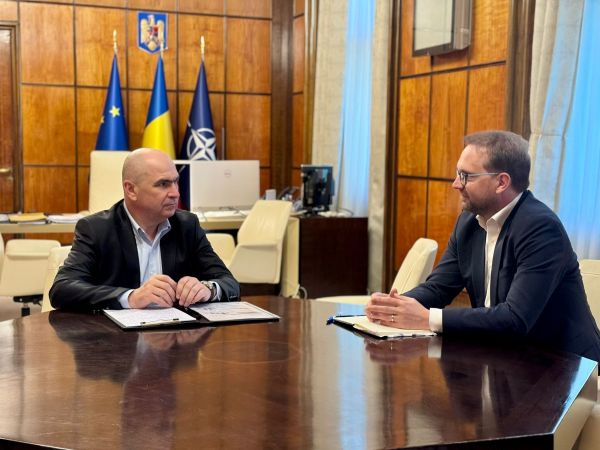
Dominic Fritz, the leader of the liberal Save Romania Union (USR), proposes cooperation between political forces that recognise that Romania needs deep, effective reforms. The no-confidence vote on 5 May in the Romanian parliament against the pro-EU and reformist government of Ilie Bolojan deepened the most severe political crisis in Romania’s post-communist history.
An “unholy alliance” between the social democrats and pro-Kremlin far-right extremists threatens to spread political chaos and isolate the country within the EU. Fritz, who is also the Mayor of Timișoara, the economic capital of western Romania, reached a significant agreement with the President of the conservative National Liberal Party (PNL), Ilie Bolojan, on 8 May, aimed at protecting democratic rules. The leaders of PNL and USR committed to defending the path of reform and integrity, which served as the basis of the Bolojan coalition government.
The Social Democratic Party (PSD) and the far-right opposition Alliance for the Unity of Romanians (AUR) jointly submitted the motion to Parliament on 28 April.
In the previous month, the PSD withdrew from the government coalition. In the vote, 281 lawmakers supported the motion, while only four opposed it. Members of Bolojan’s National Liberal Party (PNL), along with coalition partners Save Romania Union (USR) and the small ethnic Hungarian UDMR party, abstained.
Surprisingly, the President of Romania, Nicușor Dan, who was also among the founders of USR, had a weak reaction, making a vague comment about what can happen in democracies. Also, the Party of European Socialists (PES) called for protecting Romanian democracy, while avoiding criticism of its member party, PSD, which caused this crisis.
“Our response to the PSD’s destructive actions against good governance and to the collaboration between PSD and AUR in Parliament is the cooperation of the reformist and responsible political forces,” Fritz said after the meeting with former PM Bolojan.
“Following an open discussion, we agreed to coordinate our next steps in response to this artificially created crisis — in Parliament, within the interim Government, and during the consultations at Cotroceni Palace. We can no longer accept the argument of a false stability used to cover up the blocking of reforms and the waste of public money. Our cooperation is the guarantee that the modernisation of institutions, integrity in public office, and the implementation of strategic investments will remain on the country’s agenda. We are not doing this for our parties. We are doing it for Romania,” Fritz posted on X on 8 May.
Pro and against EU
The situation created by the socialists seems difficult to resolve. The parliament of Romania is bicameral, consisting of the Senate with 134 seats and the Chamber of Deputies with 331 seats. To obtain a majority, it needed 68 seats in the Senate and 166 in the Chamber.
Neither of the two “fronts” can secure a comfortable majority that will allow for a stable government. The anti-EU group comprises the PSD with 36 seats in the Senate and 86 in the Chamber, and the extremist AUR with 28 (S) and 63 (C), for a total of 64 in the Senate and 149 in the Chamber.
On the other side, the pro-European forces are PNL of Ilie Bolojan with 22 (S) and 49 (C), USR with 19 (S) and 40 (C), and the ethnic Hungarian UDMR, which has 10 seats in the Senate and 22 in the Chamber. The total number of seats the pro-EU “camp” has is 51 (S) and 111 (C).
However, in both camps, the situation may not be so clear. In his initial remarks, President Dan said he will not accept a government in which AUR participates. Also, an older PES declaration condemned such a development.
AUR is not simply a far-right party. Even though it is a member of the European Conservatives and Reformists (ECR), AUR is openly pro-Kremlin and supported by the Russian interference actions in the country. The party is also irredentist – claiming the unification of Romania and Moldova – and its leader, George Simion, openly supports Greenland’s annexation by the USA.
However, President Dan could accept a minority PSD government that would secure AUR’s support in parliament. On the pro-EU side, the UDMR may soon face an internal crisis, as the Viktor Orbán regime has heavily influenced the party.
The risk Romania faces now is a weak government that will prolong the crisis and cost the country important EU funds, or lead to repeated snap elections.
