
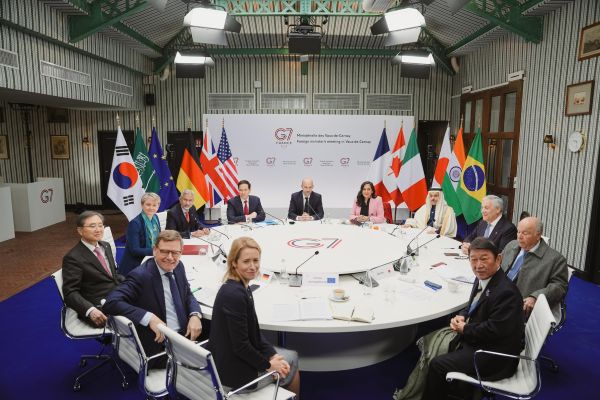
Top diplomats from the Group of Seven (G7) countries convened in France on Friday, where discussions revealed differing perspectives between the United States and its allies regarding the ongoing conflict in Iran. Despite these differences, the group reached a consensus calling for an immediate cessation of attacks on civilians and highlighted the importance of reopening the Strait of Hormuz to international shipping.
US Secretary of State Marco Rubio participated in these discussions shortly after President Donald Trump publicly criticised NATO countries, which has complicated efforts to communicate the US strategy on Iran to its allies.
President Trump has expressed concerns that allies have not adequately responded to requests for assistance in addressing Iran’s retaliatory actions, particularly its influence over the Strait of Hormuz—vital for global oil shipments, which has contributed to rising energy prices. In contrast, Secretary Rubio adopted a conciliatory tone, emphasising the US commitment to fostering international collaboration on a plan to ensure the strait remains accessible once hostilities have ceased.
In a recent statement, President Trump warned of potential consequences for Iran if the waterway is not reopened within a specified timeline, which has since been extended to 6 April. Following the discussions, Secretary Rubio expressed the ongoing challenge of maintaining an open Strait of Hormuz post-conflict and noted that Iran may attempt to impose a toll on this crucial route, which carries approximately 20% of the world’s oil, potentially resulting in significant economic repercussions for various nations.
“Not only is this illegal, it’s unacceptable. It’s dangerous to the world,” Rubio told reporters of the possibility that Iran would seek to restrict traffic through the strait. “And it’s important that the world have a plan.”
France states the Iran war’ is not ours’
America’s allies have expressed scepticism about the Iran war, as evident at the G7 foreign ministers’ meeting at a historic abbey near Paris. Four weeks into the conflict initiated by the US and Israel, concerns about oil market instability and the lack of consultation before military actions have surfaced, particularly among EU countries facing economic repercussions.
French Armed Forces Minister Catherine Vautrin asserted that the war “is not ours” and reiterated France’s strictly defensive stance, advocating for a diplomatic solution as the path to peace. British Foreign Secretary Yvette Cooper supported this view, highlighting Britain’s preference for diplomacy and acknowledging differences with the US.
“We have taken the approach of supporting defensive action, but also we’ve taken a different approach on the offensive action that has taken place as part of this conflict,” she said.
German Foreign Minister Johann Wadephul articulated Germany’s readiness to play a significant role in ensuring the security of shipping in the Strait of Hormuz following the conclusion of hostilities. He emphasised the importance of broadening the existing common ground concerning the Middle Eastern conflict. In parallel, Rubio sought to mitigate concerns about the potential for an expanded conflict, asserting that the United States could meet its objectives without deploying ground troops.
G7 diplomats agree to urge a halt to civilian attacks
French Foreign Minister Jean-Noel Barrot announced that the group adopted a declaration urging an immediate halt to attacks on civilians and infrastructure during the Iran war. “Nothing justifies deliberately targeting civilians or diplomatic facilities,” he stated, highlighting the need to restore safe navigation in the Strait of Hormuz.
Barrot added that once US military objectives are met, escort missions could help ensure the swift resumption of ship traffic, as the lack of movement from the Persian Gulf is worsening the situation. He noted that Rubio and others agree on the importance of maintaining maritime security and freedom of navigation in international waters.
However, he pointed out that Trump’s criticism of NATO allies complicates Rubio’s stance, as the former president feels other countries are not contributing enough against Iran.
“We are very disappointed with NATO because NATO has done absolutely nothing,” Trump said during a Cabinet meeting on Thursday.
Among the G7 nations, apart from the U.S., Britain, Canada, France, and Germany, Italy is a member of the transatlantic military alliance, while Japan is the only exception.
“We’re there to protect NATO, to protect them from Russia. But they’re not there to protect us,” Trump added.
Rubio stated that the US is “not asking anyone to join the war” against Iran. However, he emphasised that countries most impacted by the closure of the Strait of Hormuz “should be willing to take action, and we’ll assist them” once the conflict concludes.
Concern about Iran war’s impact on Ukraine
The conflict in Ukraine emerged as a key topic during the recent G7 meeting. While US-facilitated discussions are currently ongoing, no significant breakthroughs have been made thus far. There are growing concerns among allies that developments in the Middle East might divert US attention from its commitment to Ukraine. German Foreign Minister Wadephul underscored the importance of maintaining Ukraine’s defence capabilities during the meeting, asserting that there should be no reductions in support. After the meeting, Rubio noted that although no US weaponry has been reassigned from Ukraine to the Middle East, such a decision could be considered if deemed necessary in the future.
This article used information from The Associated Press.
