
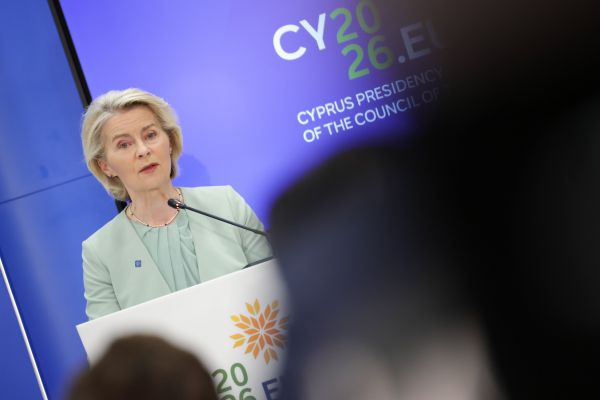
European Union countries are urged to allocate their energy aid primarily to vulnerable households and industries to prevent the misallocation of billions of euros, as the ongoing conflict in Iran affects oil and gas prices. European Commission President Ursula von der Leyen emphasised the importance of this approach on Wednesday. The tensions arising from the US-Israel conflict, coupled with Iran’s actions such as restricting access to the Strait of Hormuz, are imposing a financial burden on the EU, amounting to nearly €500 million daily. This situation is contributing to rising fuel prices and the potential for a jet fuel shortage in the near future.
Von der Leyen highlighted the need for the EU to learn from the 2022 fuel crisis, during which Russia utilised its energy resources to undermine European support for Ukraine. She pointed out that over €350 billion was spent on untargeted measures that significantly affected the financial stability of member states. She stated, “Let us not repeat the same mistakes; we must focus our support where it is most needed.”
As Europe has successfully reduced its energy dependency on Russia, it is now imperative for the bloc to eliminate reliance on external supplies. This objective can be achieved by enhancing the utilisation of renewable energy sources, such as wind and solar power, alongside nuclear energy, as emphasised by von der Leyen.
“Our overdependency on imported fossil fuels makes us vulnerable,” she said.
Since the onset of the war in 2022, imports of Russian gas into the 27 members of the European Union have decreased from 45% to approximately 12% as of last year. Following the imposition of sanctions, coal imports have been completely banned, and oil imports have dropped significantly from 27% in 2022 to just 2%, with only Hungary and Slovakia continuing to purchase from Russia.
Ursula von der Leyen highlighted that the ramifications of the Iran war may resonate for months or even years. She emphasised that achieving energy independence necessitates a focus on domestically produced, affordable, and clean energy sources, encompassing both renewables and nuclear energy. She encouraged EU member states to increase their reliance on electricity generated from renewable and nuclear sources to support transportation and heating, and to reduce dependence on fossil fuels in industrial practices. Presently, electricity accounts for less than a quarter of the bloc’s overall energy consumption.
EU Energy Commissioner Dan Jørgensen cautioned last week that the Iran war has resulted in more than a transient rise in prices; he described this situation as a crisis of potentially comparable magnitude to the energy crises of 1973 and 2022 combined. He expressed concern that Europe finds itself on the defensive, with limited control over ongoing developments.
“Even in a best-case scenario, it’s still bad,” Jørgensen said. “Whether or not we will be in a security of supply crisis is primarily a result of what goes on in the Middle East. What we can do is to try and prevent, and limit” the damage.
This article used information from The Associated Press.
