
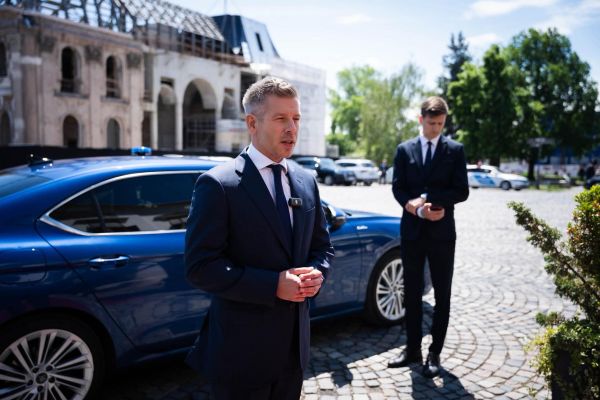
Hungary has summoned the Russian ambassador in light of a significant drone attack near its border with Ukraine, indicating a notable shift in diplomatic tone under the leadership of new Prime Minister Péter Magyar. This change contrasts sharply with the previous administration’s close ties to the Kremlin, which were established during the tenure of former Prime Minister Viktor Orbán.
Ambassador Evgeny Stanislavov was set to meet with Hungarian Foreign Minister Anita Orbán at the foreign ministry around noon on Thursday to discuss the recent strikes in the Ukrainian region of Transcarpathia, which is home to a considerable Hungarian minority.
Prime Minister Magyar strongly condemned the Russian aggression during a press conference in Ópusztaszer, stating, “The Hungarian government firmly denounces the Russian attack on Transcarpathia.” He further mentioned that the foreign minister would convey this message to the ambassador and inquire about Russia’s plans to conclude the ongoing conflict, which has persisted for over 4 years.
As of now, the Russian government has not issued any public statements concerning the summons. On Wednesday, Russia conducted a substantial drone offensive, deploying at least 800 drones in broad daylight, targeting approximately 20 Ukrainian regions, including Transcarpathia. Ukrainian President Volodymyr Zelenskyy reported that this assault resulted in six fatalities and numerous injuries, including among children. This attack was characterised as one of the longest sustained offensives by Moscow during the five-year conflict.
President Zelenskyy referred to the summons in Budapest as an “important message” and expressed appreciation for Magyar’s statements, emphasising Moscow’s perception as a recurring threat not only to Ukraine but also to neighbouring countries and Europe at large.
Following his historic electoral victory over Orbán in April, Prime Minister Magyar has committed to addressing and reversing various aspects of Orbán’s 16-year legacy, particularly regarding corruption concerns. This summons reflects a dramatic change in Hungary’s previously close relationship with Russia, especially in the context of Hungary’s membership in both the European Union and NATO, despite the ongoing situation following Russia’s full-scale invasion of Ukraine in 2022.
In March, Ambassador Stanislavov addressed Magyar in an open letter published on Facebook, denying that Moscow was supporting Orbán. He stated, “It is unnecessary to alarm the Hungarian populace with fictitious Russian threats.” He also outlined the objectives of the Russian embassy, which include fostering normal bilateral relations, promoting mutually beneficial cooperation when feasible, and safeguarding the interests of citizens from both Russia and Hungary.
This article used information from The Associated Press.
