
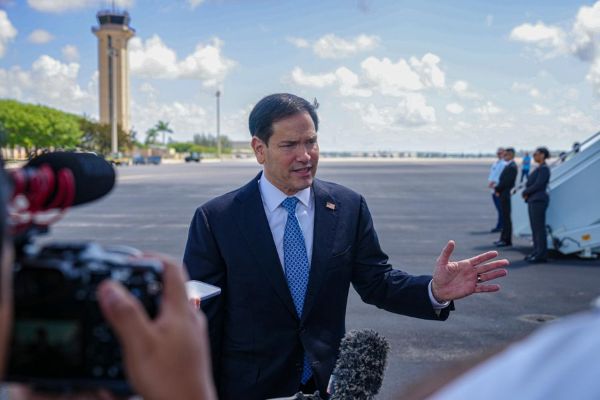
Secretary of State Marco Rubio is currently on a diplomatic mission to reassure US allies in Europe about the Trump administration’s intentions regarding NATO. His objective is to foster a more positive dialogue amid ongoing uncertainties surrounding potential reductions in American troop deployments.
Rubio will participate in a NATO foreign ministers’ meeting in Sweden on Friday, which aligns with a briefing by senior Pentagon officials at the alliance’s headquarters in Brussels. This briefing will address the US military’s commitment to European defence and involves representatives from all 32 member countries.
The meeting of diplomats is particularly timely, as it precedes a NATO leaders’ summit scheduled for July in Turkey. It also occurs amid considerable unpredictability regarding the conflict in Iran and the stalled US initiatives to resolve the ongoing Russia-Ukraine conflict. In addition, there continues to be frustration among European allies over President Donald Trump‘s criticisms of NATO partners and his comments about Greenland, a territory of Denmark, a NATO ally.
Rubio has been frequently requested to present a more measured and diplomatic approach representative of the Trump administration at such critical meetings. His previous participation in similar engagements this year includes the Munich Security Conference in February and, more recently, a visit to Italy, where he engaged with Italian officials and Pope Leo XIV following Trump’s remarks on the Pope’s positions regarding crime and the Iran conflict.
Confusion about US troops in Europe
During his departure for Sweden, Rubio chose not to comment on potential adjustments to the American military presence in Europe, including the possibility of reducing troop levels under the NATO Force Model, which is designed to address European defence in the event of significant security concerns.
The Trump administration had previously decided to cancel the deployment of thousands of US troops to Poland and Germany. However, Trump recently announced via social media that “the United States will be sending an additional 5,000 troops to Poland.”
However, it remains unclear whether this indicates that the brigade, which initially halted its deployment to Poland, will now be deployed, whether additional troops will be sent beyond this rotational deployment, or whether a drawdown of US troops in Europe is still under consideration.
The Pentagon has referred inquiries regarding this matter to the White House, which has not yet responded to clarification. While addressing reporters in Miami before departing for his flight, Rubio said that both Trump and other administration officials, including himself, are “very disappointed” with NATO, particularly regarding its response to the situation in Iran.
Rubio has expressed concerns regarding the response of some NATO allies, particularly Spain, to the current situation with Iran. He noted that these allies have denied access to US military bases, which could be vital for conducting operations related to the conflict. Additionally, he highlighted that several countries have shown reluctance, if not outright resistance, to join a coalition focused on reopening and safeguarding the Strait of Hormuz, a crucial maritime route for oil shipping that Iran has significantly restricted.
“I know why NATO is good for Europe, but why is NATO good for America?” Rubio asked rhetorically. “So, when that is the key rationale for why you’re in NATO, and then you have countries like Spain denying us the use of these bases, well, then, why are you in NATO?”
Rubio pointed out that almost all NATO allies agree Iran should not develop nuclear weapons; however, few, if any, supported Trump’s actions to prevent this.
“He’s not asking them to commit troops. He’s not asking them to send in their fighter jets. But they refuse to do anything, and so I think the president looks at that and says, ‘Hold on a second,'” Rubio said. “I think we were very upset about that. The president has made that very clear.”
NATO officials have downplayed changes to US troop levels in Europe, stating that these adjustments have been long planned and should not be surprising. However, some allies were caught off guard, especially given US commitments to prevent security gaps. Additionally, Trump’s unexpected stance on Poland added to the confusion.
NATO Secretary-General Mark Rutte said that US allies have known for a year about troop withdrawals and stressed the need for Europe and Canada to take greater responsibility for NATO’s defence. He noted that while the US will remain involved, it may redirect resources elsewhere.
US General Alexus Grynkewich assured that security in Europe would not be compromised but warned of potential further troop reductions. The Trump administration has indicated that Europe will need to handle its own security, including that of Ukraine, moving forward.
This article used information from The Associated Press.
