
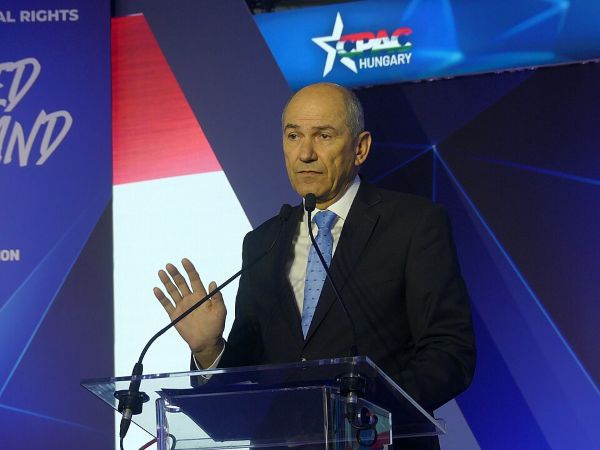
On Friday, 22 May, the National Assembly of Slovenia held a secret ballot in which Janez Janša, the right-wing populist leader of the Slovenian Democratic Party (SDS), was elected as the new Prime Minister. He secured 51 votes in favour and 36 votes against, marking the beginning of his fourth term and the establishment of Slovenia’s 16th government. Following this election, Janša must submit his proposals for ministerial candidates within the next 15 days.
Janša’s candidacy was supported by 48 deputies from the SDS, along with members of New Slovenia – Christian Democrats (NSi), led by Jernej Vrtovec, and the centre-right Democrats, led by Anže Logar. Additionally, the anti-vaccination right-wing populist party Resni.ca, led by Zoran Stevanović, will remain outside of the governing coalition. This election has elicited a variety of reactions from both European and global audiences.
“Congratulations, dear Janez Janša, on your election as Prime Minister of Slovenia,” the President of the European Commission, Ursula von der Leyen, wrote on X. She expressed her anticipation of collaboration to tackle shared challenges, including enhancing security, economic resilience, and global competitiveness.
Janša has emerged as the leader of the Slovenian right, successfully guiding his party, the SDS, to become a well-structured organisation. In recent years, he has steered the party towards a radical, populist right-wing approach, drawing parallels with the political landscapes of Viktor Orbán‘s Hungary and Donald Trump.
Janša received congratulations from several leaders, including the prime ministers of Croatia, Italy, and Ukraine, as well as Viktor Orbán, the former Prime Minister of Hungary, and Israeli Foreign Minister Gideon Sa’ar.
European Council President António Costa and European Parliament President Roberta Metsola both expressed their eagerness to work with Janša. Metsola emphasised the importance of security and prosperity for Slovenia and Europe. Manfred Weber, the conservative leader of the European People’s Party (EPP), praised Janša’s experience in strengthening Slovenia.
Croatian Prime Minister Andrej Plenković looked forward to continued cooperation between Croatia and Slovenia, noting their strong ties and shared challenges. Orbán highlighted Janša’s perseverance during the election campaign, calling it a new chapter for Slovenia.
Italian Prime Minister Giorgia Meloni expressed confidence in fruitful cooperation between Italy and Slovenia. Meanwhile, Ukrainian Prime Minister Yulia Sviridenko thanked Slovenia for its support against Russian aggression and expressed interest in deepening economic ties and cooperation.
Opposition concerned about Janša’s fourth term
Janša’s upcoming government is already facing criticism from opposition parties, including the liberal Freedom Movement (Svoboda) of former Prime Minister Robert Golob, the Social Democrats (SD), Levica (Left), and the Vesna Green Party, who believe it will be even stricter in its fourth term.
In addition, concerns have emerged about whether the SD provided the crucial 51st vote for Janša, a claim the SD has firmly denied. SD president Matjaž Han stated that no SD lawmakers supported Janša in the secret ballot.
Borut Sajovic, the leader of the Svoboda parliamentary group, claimed that Janša is historically divisive in Slovenian politics. He emphasised that political manipulation would not result in better housing or wages for citizens. Sajovic also commented on Janša’s assertion that this is not a minority government, indicating that the anti-vaccination Resnica will have a clear role in the administration.
Asta Vrečko, co-coordinator of the Left, said that Janša’s election was expected and warned that his government would be more stringent. She announced plans to collect 40,000 certified signatures for a legislative referendum against the intervention law for Slovenia’s development, starting on 1 June. She urged the creation of a network supporting an open, democratic, and inclusive society.
Concerns about the democratic future of Slovenia
Concerns have emerged regarding the state that Slovenia’s right-wing populist politician intends to create. A parliamentary inquiry report presented before the elections accused the conservative parties SDS and NSi of establishing a system to divert public and private funds into media and political structures aligned with their interests from 2020 to 2022. The 500-page report revealed a “sophisticated system of bypass financing” involving state-owned enterprises, advertising contracts, private donations, and foreign investments.
Additionally, leaked recordings and videos have unsettled Slovenia’s political landscape, leading to allegations of corruption and foreign meddling. The high-quality materials surfaced on social media and a new website, featuring conversations with former officials and a lawyer. Those implicated have denied the claims, arguing the recordings were manipulated.
In light of the scandal, the government convened the National Security Council to investigate national security implications and possible foreign interference. However, this investigation is likely to be halted under the new government.
Under the leadership of Prime Minister Robert Golob, Slovenia was one of the few EU countries to recognise an independent Palestinian state formally. In the past year, the government enacted an arms embargo on Israel in response to the Gaza bombing campaign and issued strong statements condemning the actions of Prime Minister Benjamin Netanyahu, all while serving as a non-permanent member of the United Nations Security Council.
Furthermore, Israel’s foreign minister’s sincere congratulations to Janez Janša upon his election as prime minister underscored the relief felt by the Israeli government. Before the elections, reports indicated that Janša engaged with officials from the Israeli private intelligence firm Black Cube. While Janša acknowledged consulting with a Black Cube advisor, he has firmly denied any allegations of wrongdoing.
Looking ahead, Janša has expressed intentions to revise Golob’s domestic agenda, proposing tax incentives for businesses while suggesting reductions in funding for civil society, welfare, and media initiatives.
As of Friday, Slovenia has embarked on a critical transition, and the period ahead will determine whether it continues to uphold its democratic welfare state or shifts towards an illiberal form of governance.
