
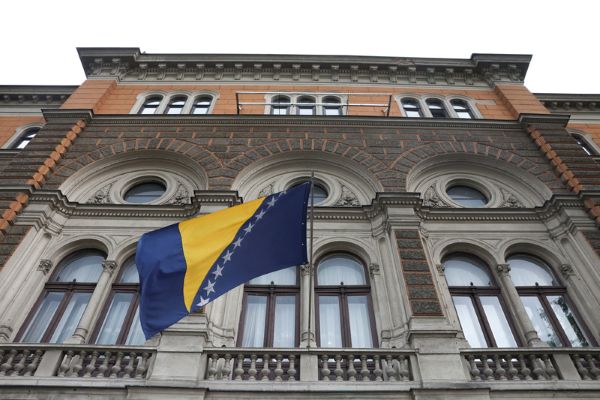
European Council President António Costa remarked on Monday that this week’s European Union summit with the candidate countries from the Western Balkans aims to affirm the authenticity of the enlargement process. While commencing a pre-summit tour in Bosnia, Costa highlighted that in light of global geopolitical uncertainties and economic instability, “enlargement represents a geostrategic interest for Europe.”
“It (enlargement) is an investment in the peace, stability and security of our continent,” Costa added. “This tour is a clear sign that the commitment of the European Union to the Western Balkans is real. As real as the opportunity for enlargement.”
On Friday, Costa will co-chair a significant summit in Montenegro, which will convene EU leaders and senior officials from Albania, Bosnia-Herzegovina, North Macedonia, Kosovo, Serbia, and Montenegro. Each of these six countries is at a distinct phase in the EU accession process, with Montenegro and Albania currently at the forefront. The European Union has expressed a commitment to promoting reforms in these candidate countries, motivated by concerns regarding the growing influence of Russia and China. Additionally, Ukraine and Moldova aspire to join the EU, alongside approximately ten other countries.
Candidate countries are required to align their legal frameworks with EU standards across 35 policy areas, known as “chapters,” which encompass issues ranging from judicial standards to agriculture and fisheries regulations. All 27 member states of the EU must reach consensus before a chapter can be opened, and again before it can be closed.
The upcoming event in Tivat, a picturesque Adriatic Sea resort, will serve as a clear demonstration of the collective determination to advance cooperation and build on the momentum of the European Union’s enlargement, as Costa stated.
However, Bosnia continues to face challenges in this context, remaining deeply divided along ethnic lines long after the conflict from 1992 to 1995, which resulted in more than 100,000 fatalities and the displacement of millions. The leadership of the Bosnian Serb separatists, aligned with pro-Russian sentiments, has advocated for increased autonomy—an approach that initially instigated the ethnic conflict following the dissolution of the former Yugoslav federation.
Costa’s visit coincides with the anticipated selection of a new High Representative by an international body tasked with overseeing peace in Bosnia, following the resignation of German diplomat Christian Schmidt. This appointment, established under a US-brokered peace agreement, endows the High Representative with the authority to amend laws and dismiss officials who undermine post-war reconciliation efforts. Recent reports indicate that the member states of the Peace Implementation Council are currently divided in their preferences regarding the successor to this crucial role.
“If the future of the country is in the European Union it’s important that the new high representative … embodies Bosnia and Herzegovina choice to pursue European Union accession,” Costa said.
He added that “now is the time to focus on your goal and accelerate the pace of reforms.”
This article used information from The Associated Press.
