
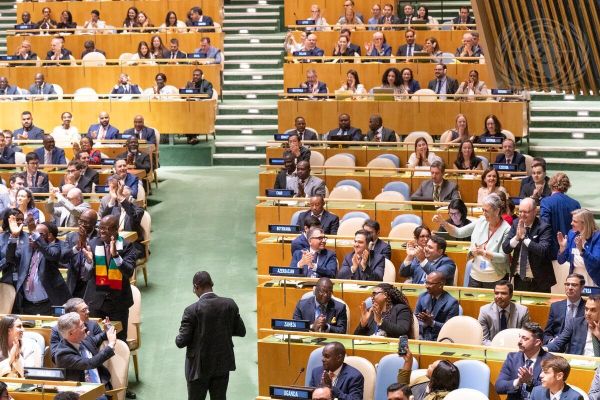
Portugal and Austria have successfully secured their positions on the United Nations Security Council, defeating Germany in a highly competitive election held on Wednesday. This election followed a rigorous campaign and reflects the ongoing dynamics within the Council, which consists of 15 members, including five permanent members with veto power: the United States, Russia, China, Britain, and France.
The 10 rotating seats on the Security Council are allocated to different global regions, with five countries elected annually by secret ballot from the General Assembly for two-year terms. In a parallel election, Kyrgyzstan emerged victorious over the Philippines after four rounds of voting, with a final tally of 143 to 49, marking Kyrgyzstan’s inaugural entry into the Council. Meanwhile, Zimbabwe and Trinidad and Tobago, representing Africa and the Caribbean respectively, were elected unopposed, each receiving more than 180 votes.
The Security Council is entrusted with maintaining international peace and security; however, it has faced challenges in effectively addressing ongoing conflicts, notably due to Russia’s vetoes on Ukraine and the United States’ vetoes on issues related to Gaza and Iran. Efforts to reform the Council to better align with contemporary geopolitical realities have been ongoing for decades, yet past initiatives have not yielded significant change. Nonetheless, a new reform effort is underway.
In the election for the two seats allocated to predominantly Western countries, Portugal secured 134 votes, Austria 131, and Germany, which has previously held six terms on the Council, garnered only 104. German Foreign Minister Johann Wadephul acknowledged the disappointment with this outcome, attributing it, in part, to Russia’s campaign against Germany, which is linked to its robust support for Ukraine. He also indicated that Germany’s historical responsibilities concerning Israel may have influenced the vote.
Austria’s foreign ministry underscored that its election concluded a 15-year campaign, representing a significant international endorsement of the country’s commitment. Kyrgyzstan’s Foreign Minister Jeenbek Kulubayev expressed an understanding of the current turbulent global climate and reaffirmed Kyrgyzstan’s intention to collaborate with fellow Council members.
The five newly elected members will officially assume their seats on 1st January, succeeding Denmark, Greece, Pakistan, Panama, and Somalia.
This article used information from The Associated Press.
