
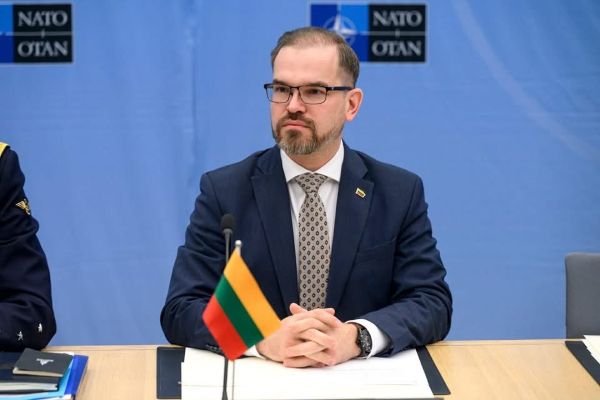
Poland and Lithuania are considering expanding their roles in NATO’s nuclear deterrence strategy. Currently, NATO’s nuclear strategy has been built around the US nuclear arsenal, with its nuclear weapons stored in six European countries as part of the security deal that exists within the alliance. Despite recent spats between US President Donald Trump and the European side of the alliance, the nuclear deterrence strategy is still in place.
Poland and Lithuania have been eyeing a bigger role within NATO, and they are in talks with NATO to expand their roles, as Lithuanian Defence Minister Robertas Kaunas told journalists, “discussions are indeed taking place. I do not want to go into details at this point as they are classified, but discussions are ongoing, and Lithuania is certainly not standing on the sidelines.”
According to FT, Poland, Lithuania, and the other two Baltic states of Estonia and Latvia seemed interested in hosting bases for US dual-capable aircraft that could carry nuclear warheads. The four countries bordering Russia are the closest to Ukraine.
Poland has openly mentioned entering the US nuclear deterrence strategy as early as 2022, when Russia invaded Ukraine. However, the current government of Donald Tusk has been more cautious on the topic, talking only about willingness to play a bigger role and categorically denying plans of hosting nuclear weapons directly. Even the US has been cautious about this option, as both Poland and Lithuania are too close to Russia to avoid any repercussions from Moscow.
However, the two countries could be added to the so-called ‘nuclear sharing light’, meaning that aircraft from them could be listed as possible carriers for nuclear weapons in case of the incapability of the first designed non-US aircraft, currently under German and Dutch command.
Poland has also welcomed the French-led initiative to have a coordinated nuclear deterrence strategy within the European Union. After Brexit, France is the only EU member state with its own nuclear warheads. The initiative could allow participant countries to carry French nuclear weapons and to participate in French military exercises concerning nuclear power.
This article used information from The Associated Press.
