
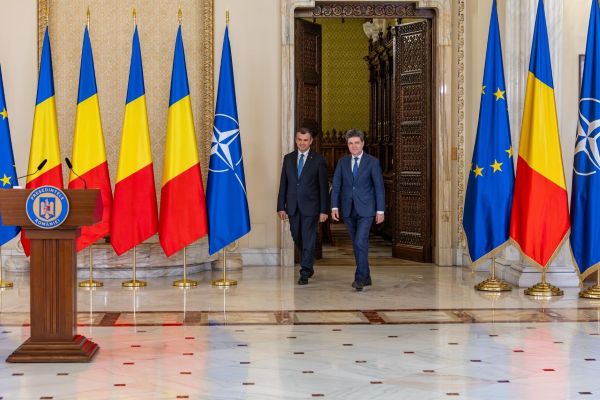
On Thursday, Romania’s President Nicușor Dan nominated one of his advisors, Eugen Tomac, to the position of prime minister. This move aims to resolve a political crisis stemming from the collapse of the previous coalition last month. Tomac, who is 44 years old and also serves as a Member of the European Parliament, has been tasked with forming a government following several weeks of deliberation and political impasse within the European Union member state. The nomination is subject to approval by lawmakers.
President Dan highlighted Tomac’s “independence, experience, and values“ as key factors that render him suitable for the prime ministerial role.
During his remarks at the Cotroceni Palace in Bucharest, Dan stated, “I have designated Eugen Tomac today to form the Government from the position of prime minister. Because the parties cannot agree among themselves, the only possible solution is a prime minister who is independent of the political formations in parliament. A prime minister who can succeed through individual discussions with each of these parties in leading Romania in the direction that the majority of citizens voted for in May 2025. That means a pro-Western direction, maintaining financial stability, the best possible completion of the PNRR, and defining the 2027 budget.”
Dan emphasised that Romanians want reform of state institutions, digitalisation, and the curbing of corruption.
“I have chosen as prime minister nominee a person independent of the parties in parliament, but who has the political experience to discuss with each of them, because consensus is needed from many parties on many issues. This is an act of responsibility on my part, and I expect the same responsibility from the parties. Eugen Tomac has the independence, experience, and values that recommend him for the position of prime minister.”
In his statement at the palace, Tomac acknowledged the significant political and economic challenges Romania is currently facing. He expressed his intention to present “a team of specialists, a technical government, not a political one“ to the parliament. “I understand the political stakes,“ Tomac stated. “These are legitimate and natural in a democratic state; however, I recognise that Romania requires national projects that can be executed effectively and clear objectives that must be achieved.”
Tomac’s nomination follows a no-confidence vote that ousted former Prime Minister Ilie Bolojan, initiated by the Social Democratic Party (PSD), which was part of the prior coalition alongside the far-right opposition Alliance for the Unity of Romanians (AUR). As a current MEP, Tomac aligns himself with Renew Europe, a pro-European liberal group. He served in Romania’s parliament from 2012 to 2019 and was appointed as a presidential advisor by Dan last year.
Expressing his vision for Romania, Tomac stated that it aligns with Dan’s aspiration for Romania to belong to the European family, to strengthen the strategic partnership with the United States, and to prioritise Romania’s role within NATO. He emphasised the importance of economic competitiveness: “A robust economy is crucial, as it is the foundation for ensuring the well-being that the citizens of Romania rightfully deserve.”
Romania is currently grappling with one of the highest budget deficits in the EU, compounded by rising inflation and a technical recession. When the coalition assumed power in June 2025, mitigating the budget deficit was a central priority. Bolojan was inaugurated with the intent of addressing one of Romania’s most severe political crises in its post-communist history.
Additionally, Tomac is a member of the European Parliament’s culture and education committee and has been involved in delegations advocating for Moldova’s pursuit of EU membership. He leads the People’s Movement Party, a small, pro-European, centre-right political faction that identifies as Christian democratic and classically liberal.
Cristian Andrei, a political consultant based in Bucharest, noted that Dan’s nomination suggests the forthcoming cabinet will likely comprise “neutral ministers, experts drawn from the state apparatus and large enterprises, but with secured negotiation support from the political parties.“ He further commented, “The degree to which the major political parties engage at lower levels of the cabinet will ultimately dictate the longevity of this arrangement. The president’s role will be to facilitate the cabinet and negotiate every political agreement through a distinct and unassuming prime minister.”
The previous coalition was composed of the PSD, the National Liberal Party (PNL), the reformist Save Romania Union (USR), and the smaller ethnic Hungarian UDMR, with support from various national minorities.
This article used information from The Associated Press.
