
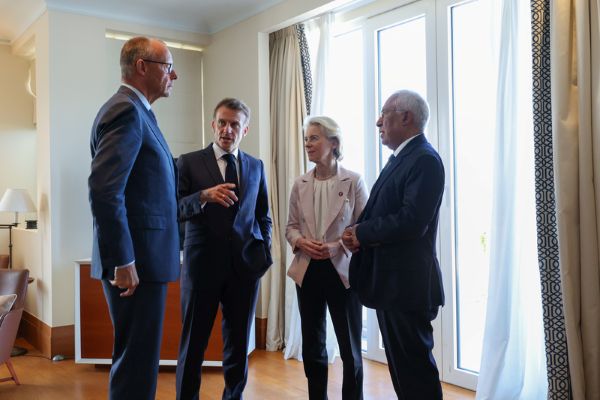
Leaders from the European Union (EU) and the Balkans are convening in Montenegro on Friday to discuss the potential expansion of the EU to include various countries within the region. This initiative is considered essential for countering the security and economic challenges posed by Russia and China.
The EU-Western Balkans summit, taking place in Tivat, a picturesque coastal town along the Adriatic Sea, will feature prominent figures, including French President Emmanuel Macron, German Chancellor Friedrich Merz, and Italian Premier Giorgia Meloni, alongside leaders from other EU candidate countries in the Balkans and European Commission President Ursula von der Leyen.
A primary focus of this summit will be Montenegro’s bid for EU membership. This small, mountainous country, which was once part of Yugoslavia, recently marked the 20th anniversary of its declaration of independence from Serbia. Following its accession to NATO in 2017, Montenegro, with a population of approximately 623,000, has set an ambitious goal of becoming the 28th EU member by 2028. The “28 by 28” motto has been prominently featured on one of Montenegro’s national airline’s planes.
The European Union has already established a working group tasked with drafting an accession treaty for Montenegro, indicating that EU membership is attainable. Montenegro is considered a leading candidate in the region, outpacing other countries such as Albania, Bosnia-Herzegovina, Serbia, Kosovo, and North Macedonia, which are all at various stages in the accession process. The EU has been actively encouraging reforms in these candidate states due to concerns regarding the growing influence of Russia and China.
To achieve EU membership, candidate countries must align their legal frameworks with 35 policy areas, known as “chapters,” covering diverse issues such as judicial standards and agricultural and fishing regulations. Approval from all 27 EU member states is necessary before each chapter can be opened, and again before it can be closed. Additionally, Ukraine and Moldova are among approximately ten countries seeking EU membership, while Iceland is set to hold a referendum in August regarding its application.
The summit will be chaired by European Council President António Costa, who, during a recent tour of Western Balkans nations, emphasised the EU’s serious commitment to enlargement. In light of ongoing conflicts in Ukraine, Iran, and the Middle East, and amid growing uncertainties regarding Europe’s future security in light of a perceived decline in US commitment to its NATO allies, EU countries are working diligently to enhance their military capabilities to respond effectively to what is seen as an increasingly aggressive Russia.
In a statement made in Serbia following a meeting with Serbian President Aleksandar Vucic, President Costa conveyed that, during times of “global geopolitical uncertainty and economic instability,” the enlargement of the EU represents “not just an opportunity; it is a geostrategic necessity for Europe.”
Faruk Bašić, a researcher at the Brussels Institute for Geopolitics, suggests that the summit will likely expedite Montenegro’s efforts to achieve EU membership by 2028. Moreover, it is expected to introduce new safeguards ensuring that member countries adhere to EU norms. This summit is particularly notable as it marks the first gathering of EU leaders since the significant political shift in April, when Hungary’s former Prime Minister Viktor Orbán, known for his alignment with Russia and for undermining EU democratic standards, was defeated in an election.
Drawing lessons from Orbán’s record of democratic backsliding and the historical use of veto power within the European Council, the EU is exploring new strategies to impose financial penalties or restrict access to the single market to incentivise candidate nations to implement necessary reforms and align with EU standards.
“The EU is trying to find a way how to admit a country that isn’t fully ready to be admitted without losing the ability to hold it accountable after the fact,” Bašić said, pointing to Ukraine’s accession bid as well as countries in the Western Balkans like Serbia and Kosovo.
This article used information from The Associated Press.
