
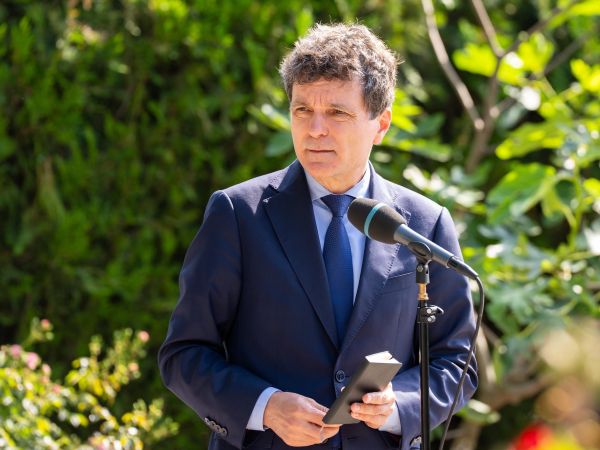
Romanian President Nicușor Dan has characterised an alleged Russian sabotage plot from last month as a “grave violation” of Romania’s sovereignty and security. His remarks were made in the context of rising apprehensions regarding the potential for Russia’s ongoing military actions in neighbouring Ukraine to extend beyond its borders.
These statements followed the release of information from the Romanian Intelligence Service, which identified a Russia-coordinated “sabotage network” connected to a fire that occurred on 14 September in central Brașov County. This incident resulted in damage to several commercial establishments.
The intelligence service released video footage showing an individual ascending a building’s fire escape, followed by flashes and flames engulfing the structure. Two individuals were later observed departing the scene on bicycles.
In a Facebook statement, President Dan condemned any involvement of Russia in acts of sabotage in Romania, calling such actions unacceptable and a serious infringement on the country’s sovereignty and security.
The day before, Romania’s Directorate for Investigating Organised Crime and Terrorism (DIICOT) announced that three foreign nationals—two from Belarus and one from Ukraine—all residing in European Union countries, are under investigation for the fire in Brașov. Two suspects were apprehended in Germany while allegedly preparing to commit similar acts, and a European arrest warrant has been issued for another individual located in Poland. Efforts are underway to extradite the three suspects to Romania.
President Dan stated that this incident is indicative of a broader “hybrid war” being conducted by Moscow, aimed at undermining European democracies. He asserted that this campaign includes election interference, disinformation campaigns, cyberattacks, and acts of sabotage. According to him, this hybrid war has manifested over the years in various forms, all with the same objective of weakening European states from within and eroding solidarity among them.
While Russia has not provided an immediate response to the allegations, it has repeatedly denied involvement in any sabotage operations against European nations. The Romanian Intelligence Service provided additional details, indicating that the network’s activities were not confined to Romania and that Russia had designated a diversity of targets across the region. These targets reportedly encompass both state-owned and private arms manufacturing facilities, as well as other sites of military and industrial significance.
The intelligence service has stated that, during investigations this year, additional attempts to target sites in Romania have been uncovered, including international military facilities and locations utilised for training Ukrainian armed forces. The Romanian Interior Ministry noted that the activities attributed to the suspects match patterns observed in previous cases linked to Russia.
Moreover, on Tuesday, Romanian Prime Minister Luca Niculescu expressed his condemnation of the alleged Russian plot and affirmed that Romanian authorities have dismantled a Russian sabotage network targeting the defence sector. He characterised such attacks as unacceptable and underscored Romania’s commitment to protecting its citizens and national integrity.
In his address, President Dan emphasised Russia’s responsibility for a series of recent attacks on civilian maritime transport in the Black Sea, which have resulted in fatalities and heightened concerns regarding the escalation of the conflict in Ukraine.
He remarked, “Let us be clear: These are not isolated incidents; rather, they constitute a deliberate and coordinated campaign designed to create division within our societies and to undermine the commitment of European states to their own security and to our collective defence.”
This article used information from The Associated Press.
